
Luxury: when customer trust in AI outpaces brand maturity, who captures the relationship?
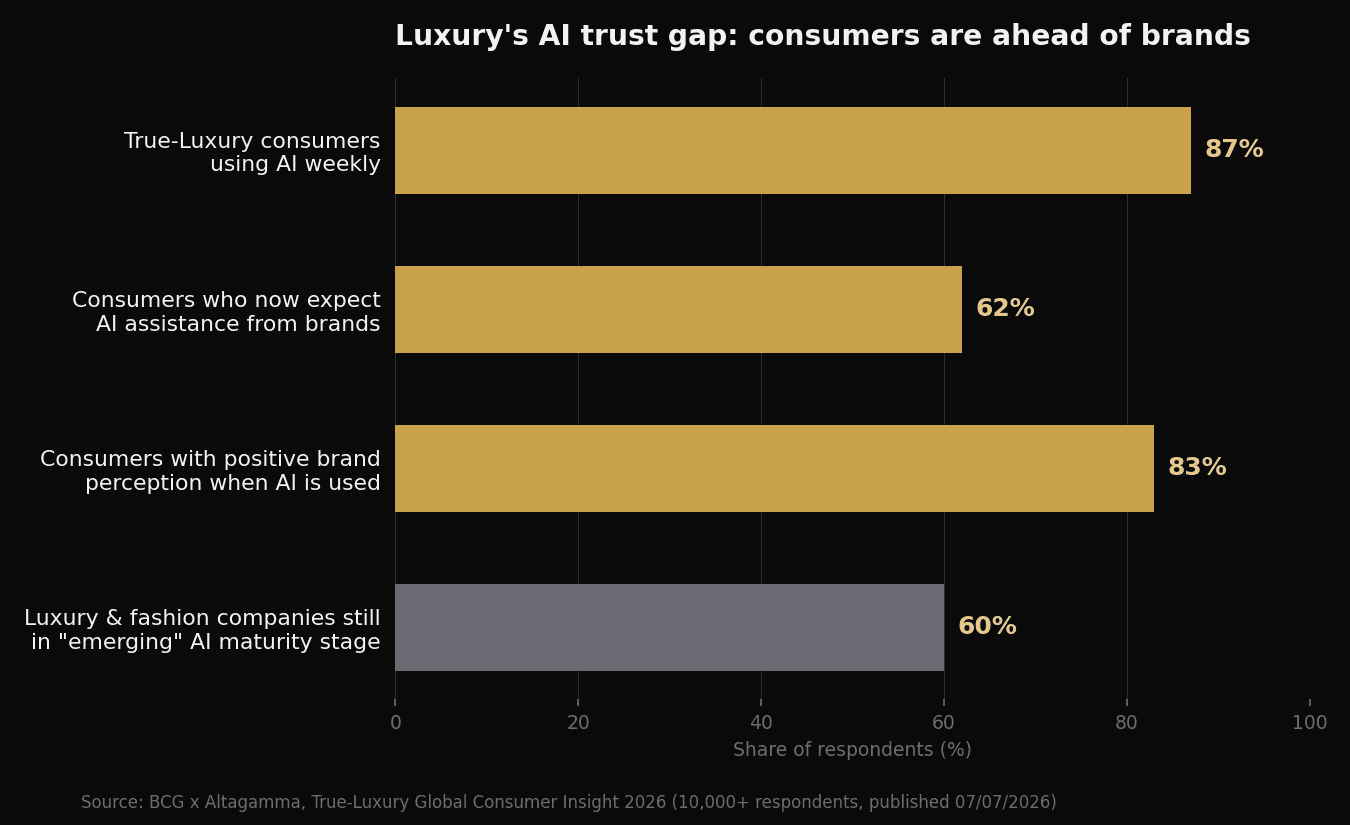
BCG x Altagamma's 2026 study shows 87% weekly AI usage among luxury consumers and 62% expecting AI assistance from brands themselves, versus only 40% of houses past the emerging AI maturity stage. An economist's read: this gap is not just an execution problem — it's a disintermediation risk on the trust layer.
The True-Luxury Global Consumer Insight 2026 study, run by Boston Consulting Group and Altagamma across more than 10,000 top-tier and aspirational luxury consumers and published July 7, 2026, delivers a two-speed diagnosis. On the demand side, generative AI has become an ordinary channel: 87% of respondents use it weekly, 40% daily, and roughly 80% already use it to research luxury purchases. On the supply side, 60% of luxury and fashion companies remain at what the study calls an emerging AI maturity stage — meaning less than half the sector has moved past that first stage.
The study's most significant finding is not the usage level itself but its effect on the brand relationship: 83% of consumers say they view a house more favorably when it uses AI in the purchase journey, 77% say they intend to keep buying from it, and 62% now explicitly expect that AI assistance to come from the brand itself. Trust, then, is not directed at AI in general — it attaches to whichever player occupies the interface layer at the moment of research and purchase decision.
This is where a classic two-sided market mechanism applies (Rochet and Tirole, 2003): when an intermediation layer captures trust and attention on one side of a market faster than the other side builds capability to occupy it, that layer becomes an obligatory passage point — and therefore a point of rent extraction. If luxury houses do not invest fast enough in their own AI assistance, third-party agents (generic shopping assistants, AI search platforms) risk installing themselves durably between the brand and its customer, capturing along the way the preference and intent data that, as we wrote on July 26 regarding L'Oréal and NVIDIA, constitutes the sector's true defensible asset.
This disintermediation risk is not symmetric across segments. Houses that already hold a strong direct relationship with their clientele — boutiques, proprietary CRM, loyalty data — have a window to internalize AI assistance before the consumer's research habit settles on an external intermediary. Houses more dependent on multi-brand distribution or generalist retail are structurally more exposed: their customer has already formed the habit of researching "through" a third party rather than directly on the brand's own site.
The maturity gap the study documents (60% still emerging) should therefore be read not as a simple technology lag to close at a comfortable pace, but as a closing window on the brand's ability to remain the trusted point of contact. The luxury market's moderate growth forecasts for 2026-2029 (2-5% then 4-7%) further suggest that few players can afford to cede control of distribution margin to an intermediary — in a slower-growing market, every margin point ceded to an intermediation layer weighs proportionally more.
This reasoning echoes what we developed on July 31 about counterfeiting: luxury brand value rests on control of provenance and the customer journey, not just downstream fraud detection. Ceding the discovery and recommendation layer to a third party, even one acting in good faith, amounts to ceding a first link in that control — with a cumulative effect that becomes hard to reverse once the consumer's research habits are set.
For a luxury house, the operational takeaway is less a question of overall AI budget than of sequencing: prioritize AI assistance at the direct customer touchpoint (site, connected boutique, customer service) over internal use cases with lower customer visibility, precisely because that is the layer the market, per the BCG x Altagamma study, is allocating right now.
Analysis by
Cardan-AI Intelligence
Our research and analysis unit, dedicated to applied AI for business, industry and regulatory compliance.
Let's talk about your next competitive edge
A 30-minute conversation to identify your most profitable AI use cases.