
US Federal AI Spending: Market Growth Is Also a Concentration of Buying Power
Between 2024 and 2026, the potential value of US federal AI contracts rose from $4.6B to $91.8B — but the share captured by the Department of Defense alone rose from 93.5% to 98.9%. An economist's reading: a textbook case of deepening monopsony, with a hold-up risk for suppliers investing in relationship-specific assets.
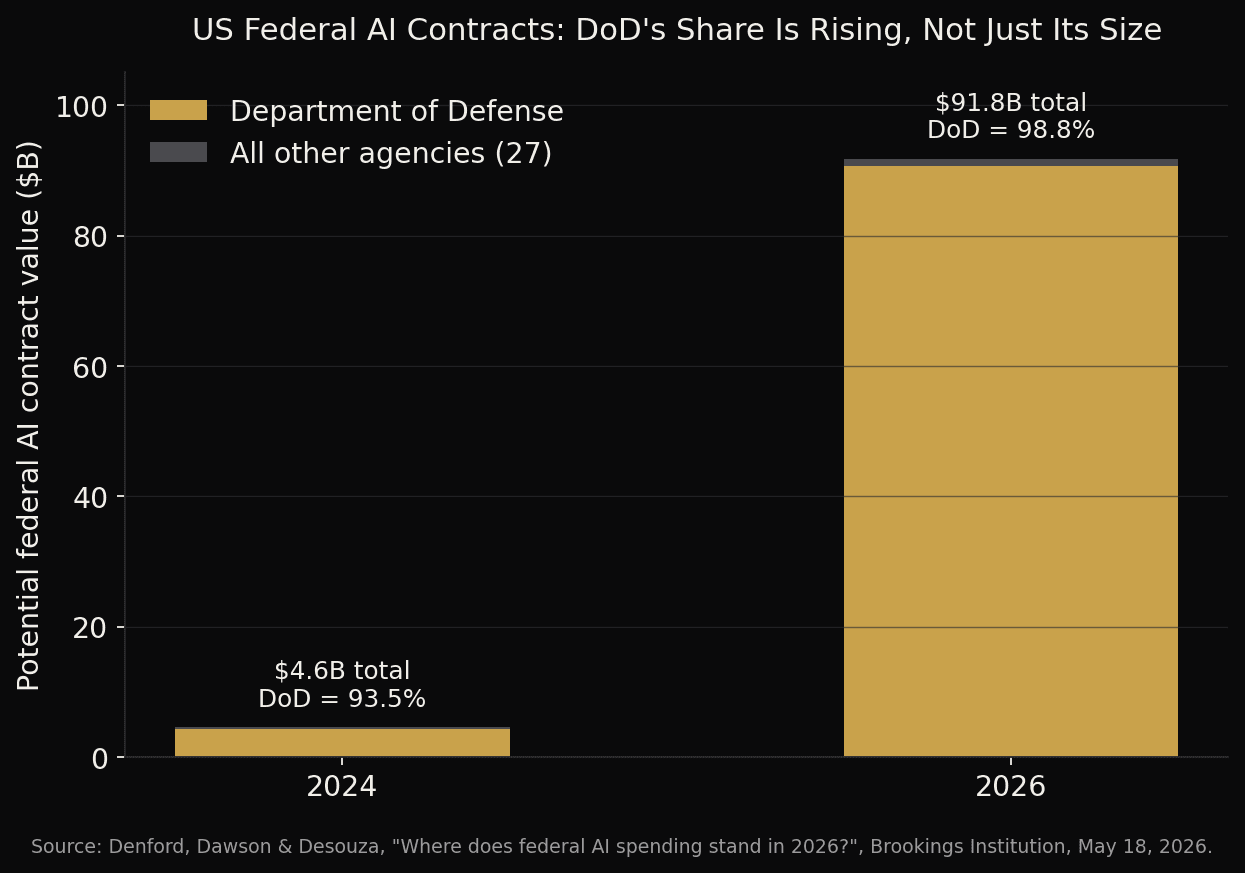
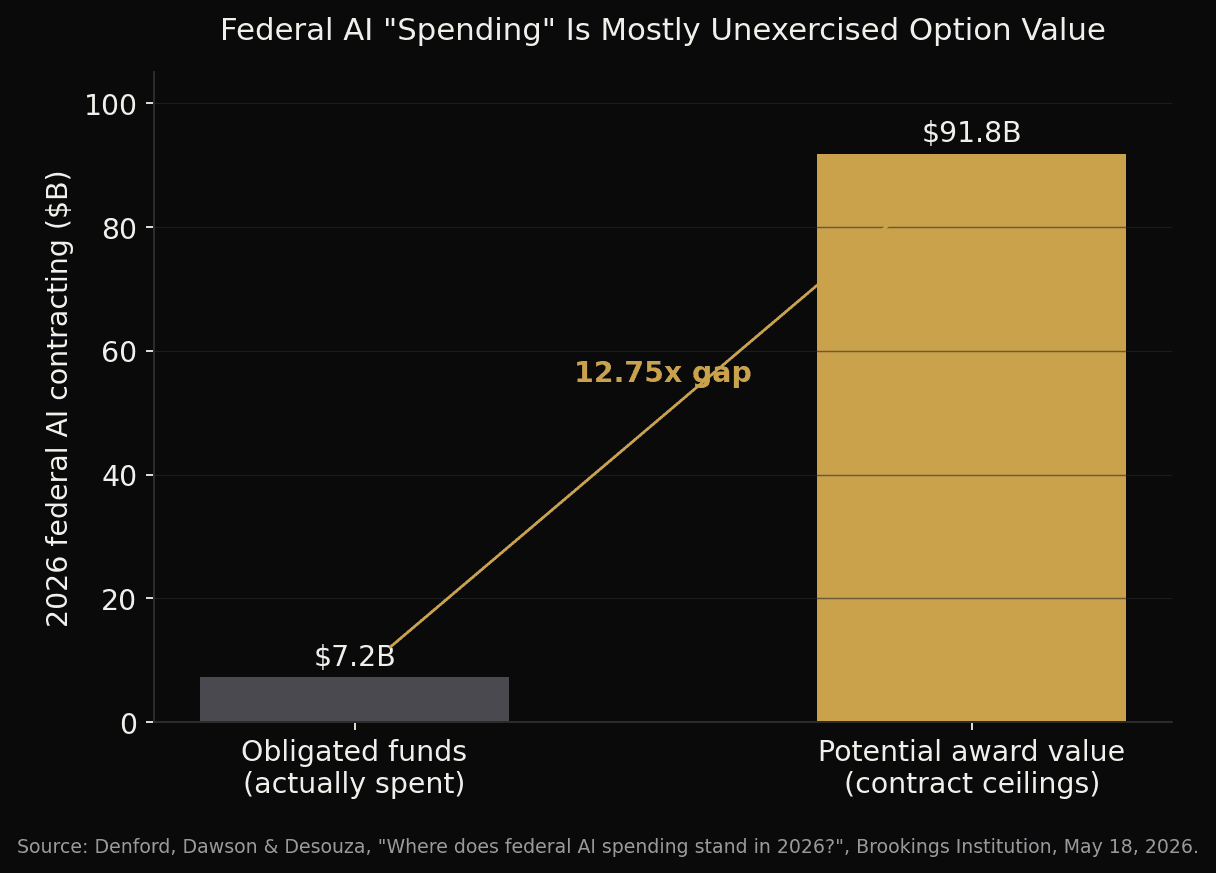
According to the analysis published May 18, 2026 by the Brookings Institution (Denford, Dawson & Desouza), the potential value of US federal AI contracts (including contract ceilings) rose from $4.6B in 2024 to $91.8B in 2026 (+1,912%), while actually obligated funds rose from $675M to $7.2B (+966%). Twenty-eight federal agencies awarded AI-related contracts over the period. The Department of Defense (DoD) dominates this total: $90.7B in potential value in 2026, or 98.9% of identified federal AI spending.
What deserves an economist's attention is not this level of concentration in itself — a dominant public buyer in a nascent technology segment is not unusual — but its trajectory. In 2024, the DoD already captured 93.5% of potential value ($4.3B of $4.6B). Two years later, in the middle of a market boom, that share did not recede toward a broader buyer base: it rose by more than five points, to 98.9%. The growth of the federal AI market and the concentration of its buying power are increasing simultaneously — not the trajectory expected of a maturing market.
The relevant analytical framework here is monopsony — a market where a single or near-single buyer accounts for the overwhelming share of demand, formalized by Joan Robinson as early as 1933 (The Economics of Imperfect Competition). In such a market, the terms of exchange — price, contractual conditions, payment cycle — are set less by supplier costs than by the dominant buyer's bargaining power. At 98.9% market share, the DoD is not one buyer among others for defense-facing AI companies: it is, de facto, the market.
This dynamic combines with a second mechanism, documented by Oliver Williamson's transaction cost economics (1979): the hold-up problem tied to asset specificity. To sell to the DoD, an AI supplier must invest in security clearances, ITAR compliance, FedRAMP/ATO authorization — assets whose value outside this specific customer relationship is close to zero. Once that investment is made, the supplier is structurally dependent on a single buyer, which mechanically strengthens that buyer's negotiating power in subsequent contract cycles.
The gap between potential value ($91.8B) and actually obligated funds ($7.2B) — a 12.75x ratio — adds a further layer of uncertainty. A large share of federal AI contracts takes the form of ceiling-based vehicles (IDIQ): the government buys itself a future purchasing option without a firm spending commitment. The supplier, meanwhile, must commit its specific investments at contract award, with no certainty the ceiling will be drawn down. It bears the execution risk of an option it does not control.
For industrial and technology companies that follow Cardan-AI in aerospace and defense, the strategic reading is direct: growing exposure to the US federal AI market is not just a growth opportunity — it is a customer risk concentration that is tightening over time, not diluting. Diversifying the revenue base — allied/NATO budgets, dual-use civilian applications, European markets — is no longer just a growth strategy; it is a monopsony risk management policy.
For non-US suppliers or new entrants without existing clearances, the entry calculation becomes economically harder to justify: the sunk cost of compliance must be weighed against a single buyer, dependent on political budget cycles, whose market share shows no sign of diluting.
Analysis by
Cardan-AI Intelligence
Our research and analysis unit, dedicated to applied AI for business, industry and regulatory compliance.
Let's talk about your next competitive edge
A 30-minute conversation to identify your most profitable AI use cases.