
The EU AI Act deadline everyone braced for just moved — and deferral is not cancellation
As of today, 2 August 2026, the EU AI Act's transparency duties and GPAI enforcement are live — with fines up to €35M/7%, above the GDPR ceiling — but the Digital Omnibus deferred the heavy high-risk obligations to 2 December 2027. Read as an economist, deferral is not cancellation: it is a discount on preparation, not on the obligation. The sixteen-month window rewards regulated sectors already fluent in conformity and punishes those who treat it as a holiday.
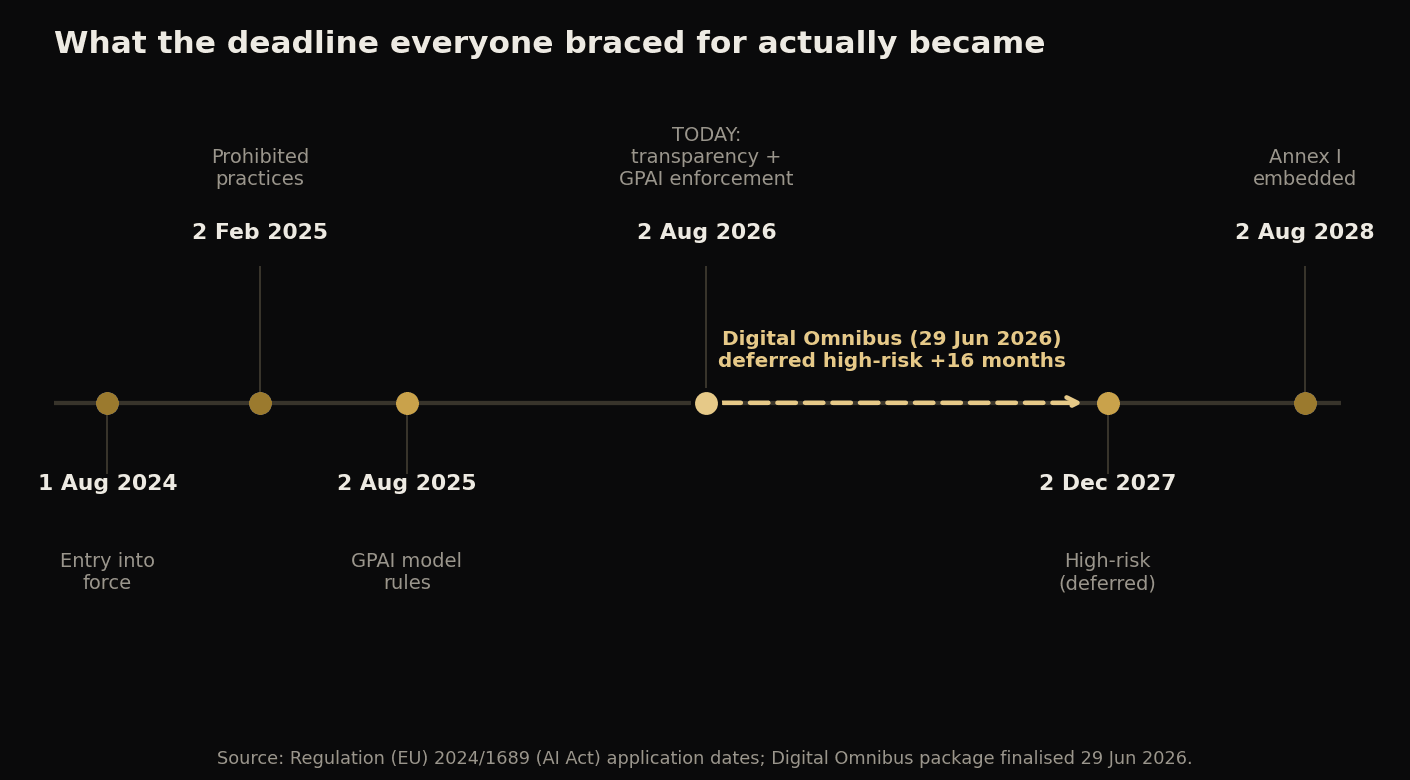
Today, 2 August 2026, is the date the EU AI Act's general-application phase begins — the milestone regulated-sector boards have circled for more than a year. And in a twist that matters far more than the ceremony, the heaviest obligations arrived, glanced at the calendar, and stepped back sixteen months. Reading that correctly is worth real money.
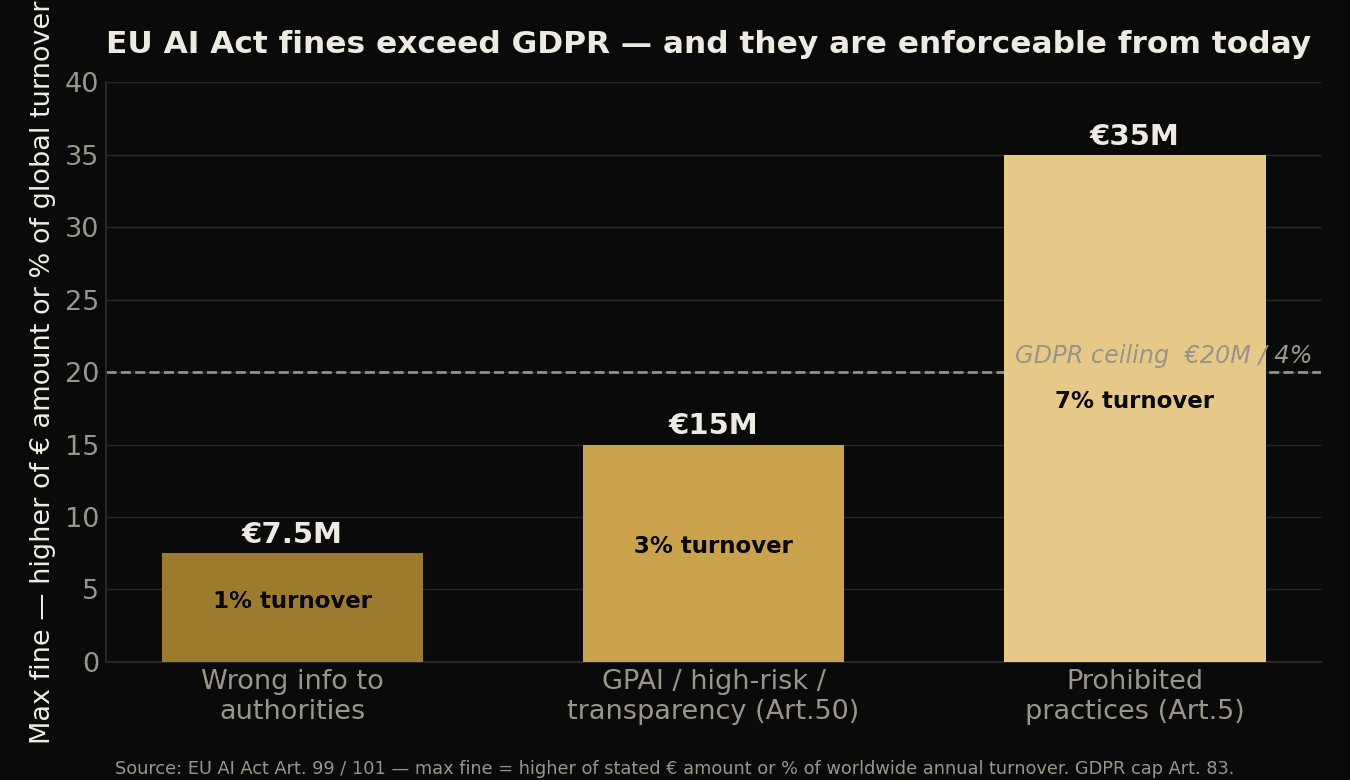
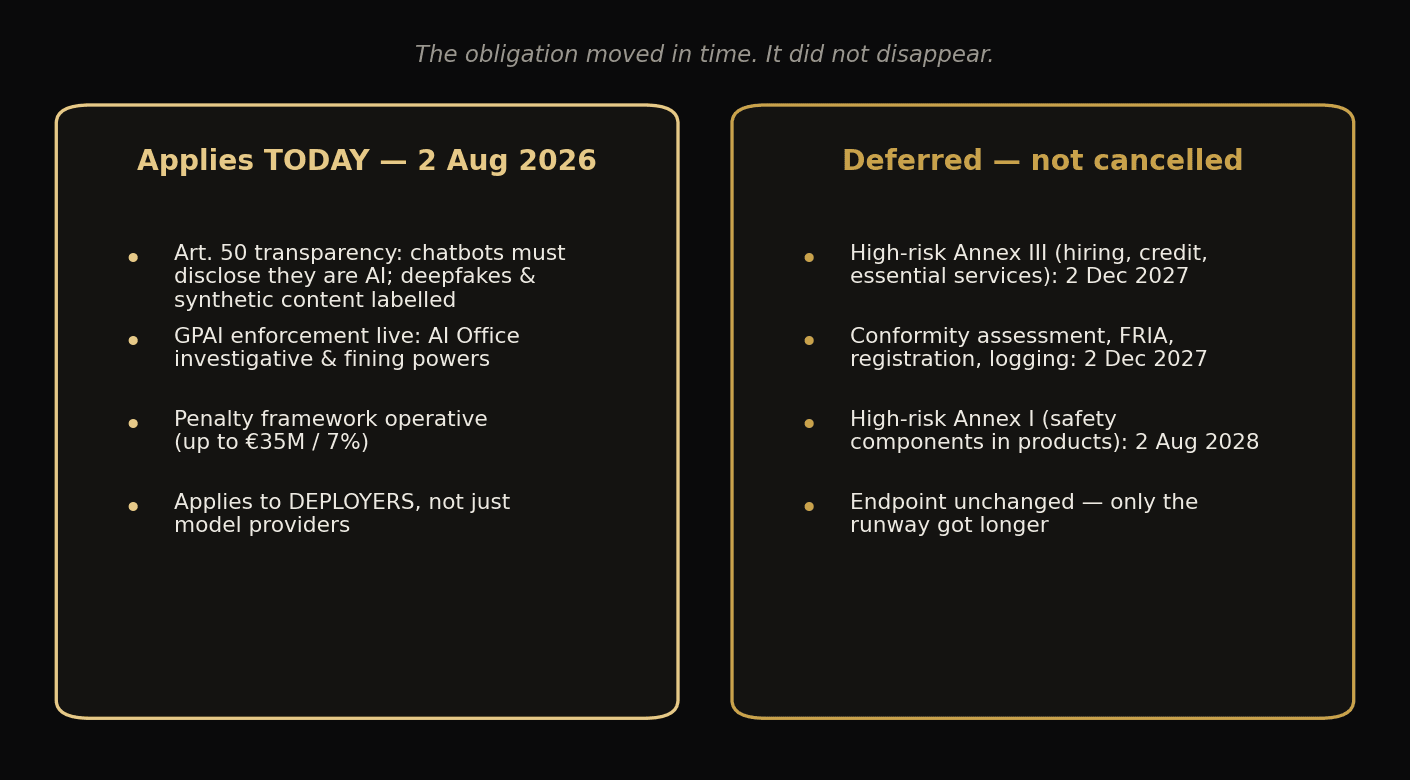
Start with what is actually live and enforceable as of today. Transparency (Article 50): any AI system that interacts with people must disclose it is AI, deepfakes and synthetic media must be labelled, and — crucially — the duty falls on deployers, not just the model makers. The AI Office's enforcement powers over general-purpose AI go operative: the technical documentation, copyright policy and training-data summaries nominally required since August 2025 now carry teeth. And the penalty architecture switches on — up to €7.5M/1% for false information to authorities, €15M/3% for GPAI and transparency breaches, and €35M or 7% of worldwide turnover for prohibited practices. Each ceiling sits above the GDPR maximum of €20M/4%.
Now what did not arrive. The Digital Omnibus simplification package, finalised on 29 June 2026, moved the high-risk obligations of Annex III — hiring and worker management, credit scoring, access to essential services, education, law enforcement — from today to 2 December 2027. The conformity assessments, fundamental-rights impact assessments, registration and logging that give the Act its operational bite for most industrial deployers now sit sixteen months further out. High-risk Annex I systems — AI as a safety component inside already-regulated products, such as avionics or medical devices — move to 2 August 2028.
The market read this as relief and priced it as a holiday. That is the mistake an economist should flag. A deferral is not a cancellation. The endpoint is unchanged; what moved is the runway. The expected present value of the compliance cost fell — it is discounted over a longer horizon and can be amortised across more quarters — but the terminal obligation is exactly as certain as it was on 28 June.
Follow that logic and it inverts the intuitive response. When a certain future cost becomes cheaper to prepare for — more time, a lower urgency premium, the ability to build controls into systems you were going to refresh anyway rather than bolt them on later — the rational move is to buy more preparation now, not less. Sixteen months of optionality is only valuable to the firm that exercises the option. To everyone else it is a snooze button, and the alarm rings on 2 December 2027 with less road to the cliff.
There is a distributional point buried here that favours industrial operators. Firms in aerospace, defence, energy, oil & gas and luxury already run conformity regimes — DO-178C, API specifications, GMP, REACH, anti-counterfeit provenance. For them the AI Act's high-risk machinery is not an alien discipline but a familiar one pointed at a new object. The marginal cost of extending an existing governance function to cover AI systems is far below the cost a digital-native firm faces standing one up from scratch. The deferral widens that gap: sixteen months is enough for the fluent to industrialise and for the unprepared to keep procrastinating.
So the instruction for a regulated-sector operator today is unglamorous and precise. Do not celebrate the deferral and do not staff down. Use the window to inventory your AI use cases against the Annex III categories, decide which are genuinely high-risk, and fold the controls into your existing conformity function while the enforcement meter is not yet running on that layer. In parallel, ship the transparency and GPAI obligations that are live today — they are cheap, broad and already enforceable. The moat, as ever in regulated industries, is not the model. It is the governance you already know how to run.
Analysis by
Cardan-AI Intelligence
Our research and analysis unit, dedicated to applied AI for business, industry and regulatory compliance.
Let's talk about your next competitive edge
A 30-minute conversation to identify your most profitable AI use cases.