
AI and energy: complementary inputs, not two separate files
The president of the American Petroleum Institute argues the US must “win the energy war before the AI war.” Behind the sectoral pitch for natural gas lies a real economic complementarity between compute capacity and energy capacity — with a risk of mutual under-investment if the two are planned separately.
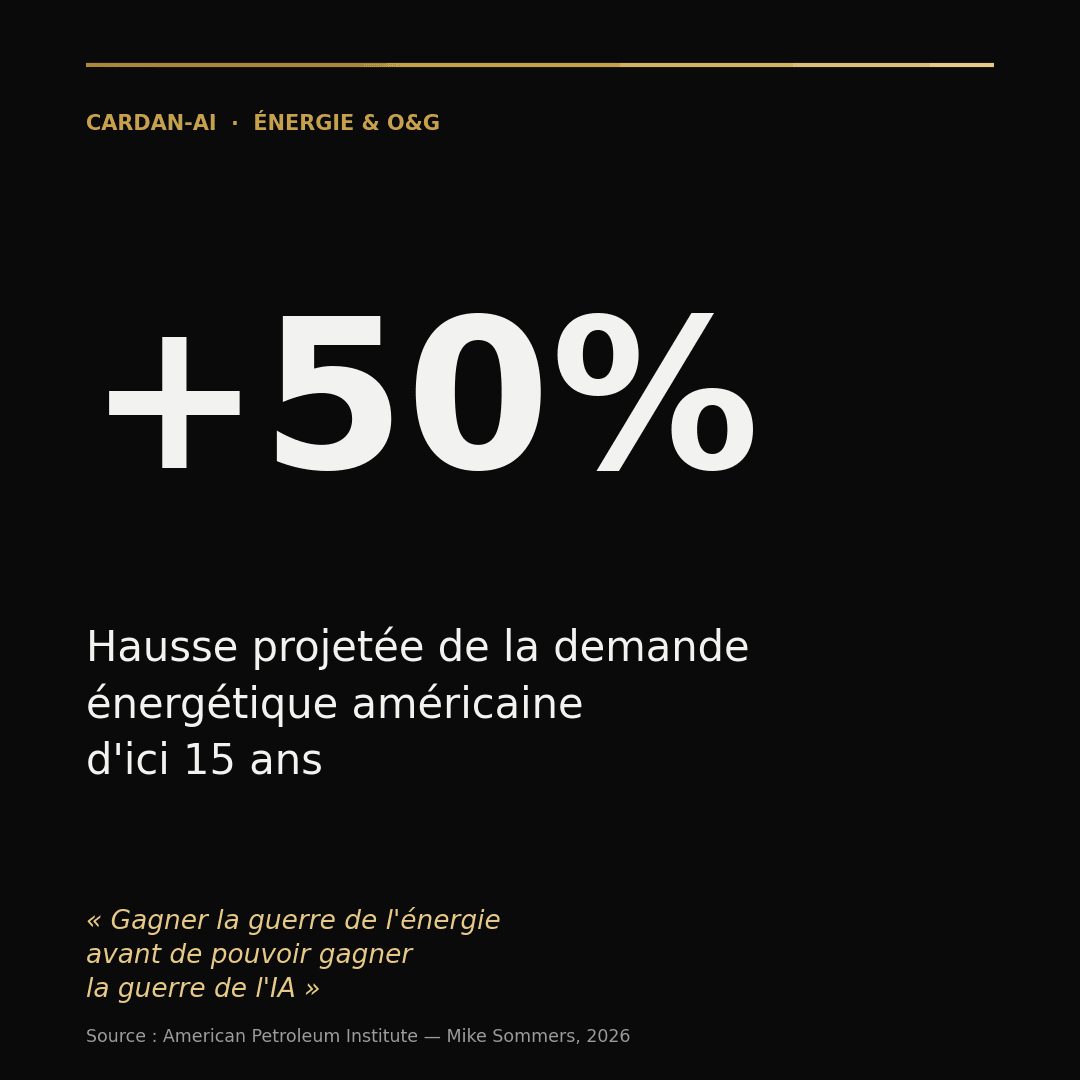
Mike Sommers, president of the American Petroleum Institute (API), the trade association representing US oil and gas producers, laid out a simple thesis in early 2026: “We have to win the war for AI. But if we don't win the War for Energy, we're never going to even be able to get to the war for AI.” In his view, America's race for AI leadership is conditioned on the availability of abundant, continuous energy — natural gas above all — to power data centers whose consumption is exploding.
API backs the thesis with three figures: US energy demand is projected to rise by roughly 50% over the next fifteen years; up to 80% of identified oil and gas resources remain inaccessible with current extraction technology; and the association says it met 90% of its two-year plan's goals in 2025. AI itself is framed as a geological and seismic exploration tool that could, over time, improve access to those reserves.
Beyond the advocacy, the argument has a precise economic structure. It amounts to treating compute (AI) and energy (continuously available, “firm” electrons) as complementary production factors with fixed coefficients, in the sense of the Leontief (1941) production function: past a certain point, adding compute capacity without matching energy capacity produces no additional useful output — the two factors must grow together, with little short-term substitutability.
This framing echoes a broader intuition about growth bottlenecks: von Liebig's law of the minimum (1840), originally formulated in agronomy, states that a system's growth is bounded by its scarcest factor, not the average of its factors. Michael Kremer's (1993) “O-ring theory” derives a similar result for economic production: when tasks or inputs are strongly complementary, failure of the weakest link drags total output down disproportionately. Applied here: AI compute capacity built out ahead of available energy capacity does not translate into proportional economic performance.
This echoes two Cardan-AI analyses published in recent weeks. On Aug 16, we documented global grid investment capped at $550bn out of $3.4tn in total energy investment (16%), against data-center electricity consumption set to rise from 485 to 950 TWh between 2025 and 2030 (+96%). On Aug 24, we noted that 92% of oil and gas companies are investing in AI but only 50% have actually deployed it — an intention-to-execution gap consistent with an underlying energy and infrastructure constraint rather than a simple technology lag.
API's framing still deserves the distance its position as a trade association requires: its direct interest is to steer the energy-AI narrative toward natural gas, presented as the only source able to provide a stable, quickly deployable energy base, rather than toward nuclear or the renewables-plus-storage pairing — both also capable, on different time and cost horizons, of providing that same stability. The complementarity between compute and energy is a solid, independently documented observation; the specific energy source being promoted remains a sectoral pitch, not a neutral economic conclusion.
One sequencing question the API narrative leaves open: who invests first — the data-center operator or the energy producer — when both investments are costly, irreversible, and made profitable by each other? This is a classic multiple-equilibria coordination problem (Cooper & John, 1988): if each party waits for the other to move first, the economy can remain stuck in a cross under-investment equilibrium, even though a higher joint-investment equilibrium would be superior for everyone.
For leaders in the sectors we cover — aerospace and defense, energy and O&G, industry, luxury — the practical implication extends well beyond the US gas debate: an organization's AI strategy can no longer be planned independently of its energy and infrastructure strategy. An AI deployment plan that ignores the availability, cost, and reliability of the underlying energy supply repeats, at company scale, the coordination failure API describes at the national level.
Analysis by
Cardan-AI Intelligence
Our research and analysis unit, dedicated to applied AI for business, industry and regulatory compliance.
Let's talk about your next competitive edge
A 30-minute conversation to identify your most profitable AI use cases.