
Defense: a venture-capital version of the Solow paradox
$19.8B in defense tech VC in Q1 2026 (+146% YoY, PitchBook), a third of it flowing to autonomous systems — while the US Department of War's 2026 AI strategy provides no adoption metrics at all. An economist's read: Solow's productivity paradox (1987), reapplied to defense financing, where capital is pricing a productivity gain no instrument yet measures.
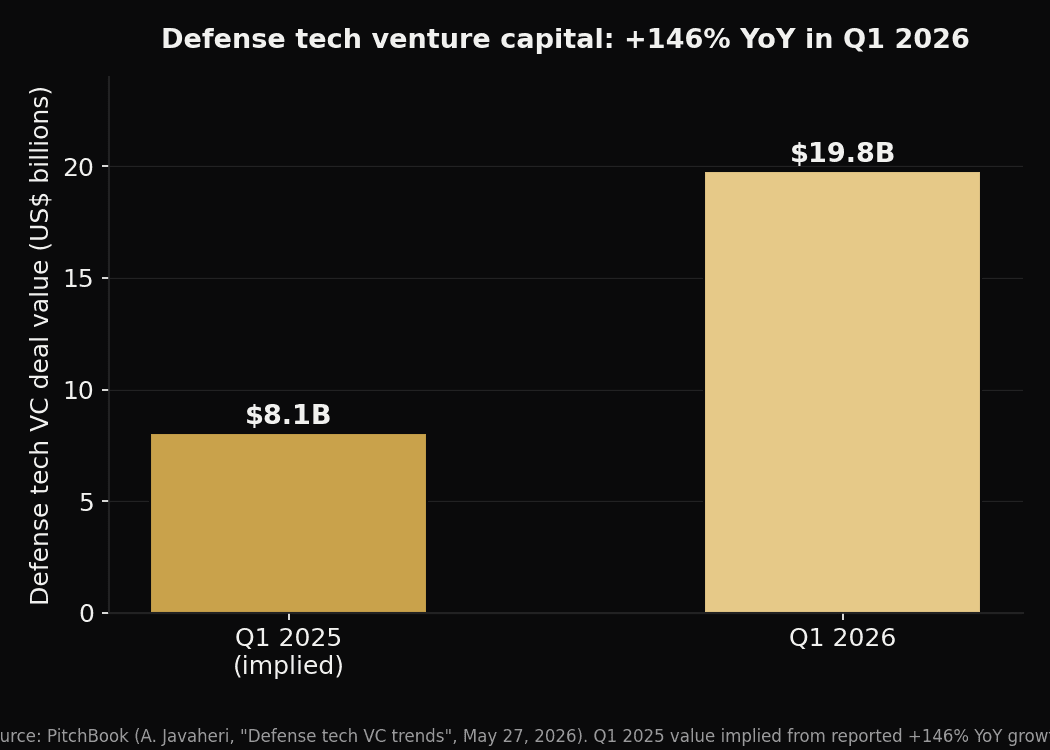
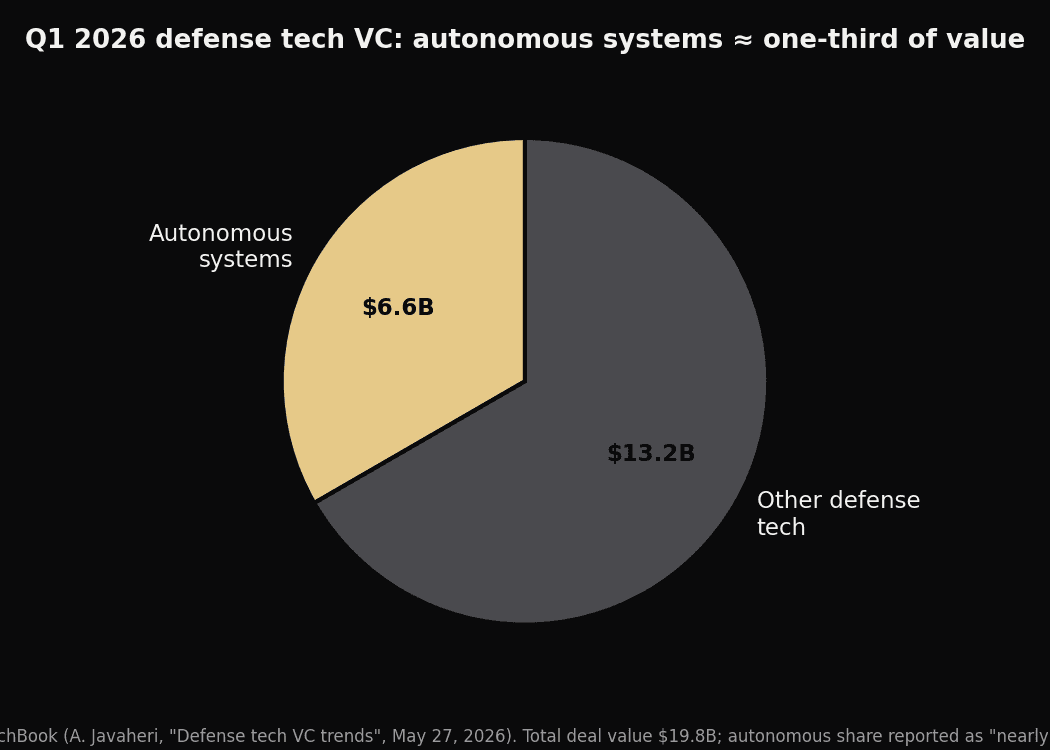
In the first quarter of 2026, venture capital invested in defense technology reached $19.8 billion, up 146% year-over-year, according to the analysis PitchBook published on May 27, 2026. Autonomous systems — drones, robotic platforms, AI-assisted command software — alone capture nearly a third of that figure, roughly $6.6 billion out of the $19.8 billion invested.
That number is worth reading against a second document published the same year: the US Department of War's 2026 AI strategy, which calls for an "AI-first" force and identifies trusted deployment — not model capability — as the main remaining constraint. Yet this budget-reference document, cited in the FY27 budget overview, provides no quantified metric of real adoption or measured productivity gains on the ground.
This configuration echoes almost exactly the paradox Robert Solow formulated in 1987: "you can see the computer age everywhere but in the productivity statistics." Defense venture capital in 2026 looks like an early, faster-moving variant of it: private capital is deploying at scale in anticipation of an operational transformation, before the end buyer — here, the US military apparatus — even has the instruments to measure whether that transformation is materializing.
From an investment-theory standpoint, this gap resembles a sector-level Tobin's Q well above 1: the valuation the market assigns to defense tech assets (venture funding here serving as a proxy) far exceeds the replacement value justified by documented operational results. Such a gap is not necessarily a bubble signal — it can reflect a rational bet on an impending doctrinal and budgetary shift — but it does concentrate risk on how quickly the buying institution catches up on measurement capacity.
The concentration of financing in autonomous systems (a third of the total) is consistent with this reading: it is the segment where the link between investment and visible operational effect — a drone that flies, a platform that patrols — is most immediately demonstrable to an investor, even absent formal institutional adoption metrics. More diffuse segments (logistics-support AI, decision aids, predictive maintenance), where the effect is real but less spectacular, may remain comparatively underfunded.
For consulting and integration providers working with the defense ecosystem, the economic lesson is twofold. First, a capital inflow is not proof of use value: due diligence should focus on genuinely instrumented use cases, not just the size of surrounding funding rounds. Second, the gap identified here — between conviction-driven financing and absent institutional measurement — is precisely the space where methodological support (defining adoption KPIs, algorithmic-trust evaluation frameworks, operational test protocols) creates differentiated value that capital alone does not produce.
Longer term, the gap between the pace of private financing and the pace of institutional measurement is also a policy signal: if the Department of War does not quickly establish credible adoption metrics, capital allocation risks continuing to be driven by narrative rather than demonstrated results — fertile ground for a correction should the budget cycle tighten.
Analysis by
Cardan-AI Intelligence
Our research and analysis unit, dedicated to applied AI for business, industry and regulatory compliance.
Let's talk about your next competitive edge
A 30-minute conversation to identify your most profitable AI use cases.