
The AI ROI paradox: output is up, returns are flat
93% of enterprises say AI improved production, only 43% say the return outpaced spend. The economist's read of the 2026 Domino / BARC report: the discriminant is not more AI budget but integrated governance — and Europe is falling behind.
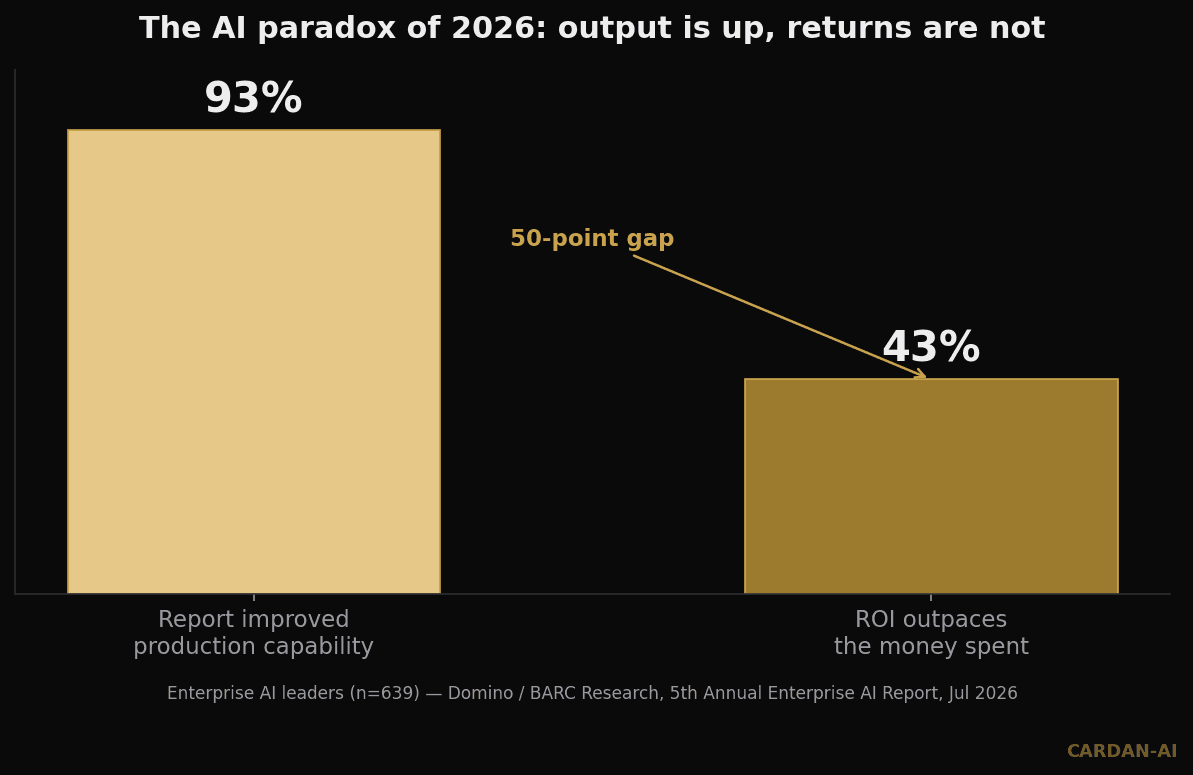
Enterprise AI has an accounting problem, and this week it acquired a number. In the Fifth Annual Domino / BARC Enterprise AI Report — a survey of 639 senior AI leaders published on 21 July 2026 — 93% of organisations said AI had improved their production capability, up from 88% a year earlier. Yet only 43% said the return actually outpaced what they spent. That second figure has not moved since 2025. The 50-point gap between the two is, for anyone reading the economics rather than the headlines, the real state of enterprise AI in 2026.
The gap exists because two different questions keep getting answered as if they were one. Producing more is a technical outcome: better models, more pilots, faster inference, a chatbot that resolves more tickets. Earning more is an economic outcome: the marginal euro invested returns more than a euro. Almost every large company has now cleared the first bar. Far fewer have cleared the second, and — this is the uncomfortable part — spending more on the same operating setup tends to widen the gap rather than close it, because it adds capability faster than the organisation can convert capability into decisions that move the P&L.
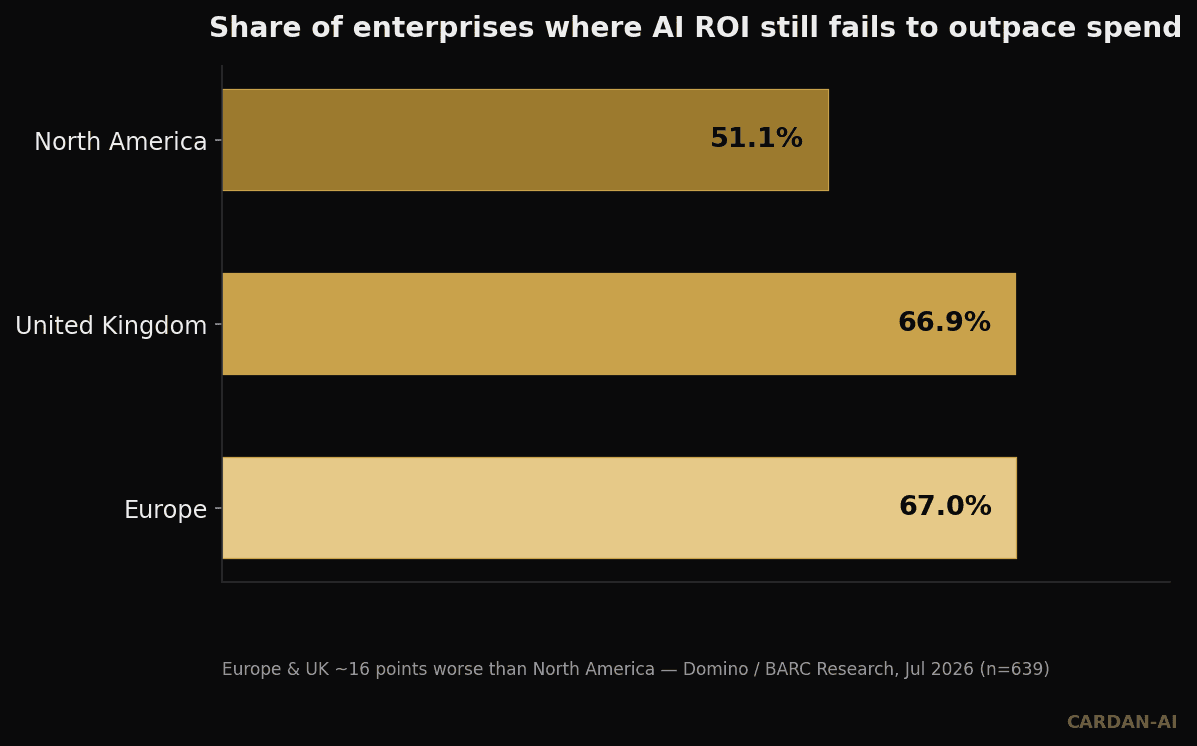
Two findings in the report sharpen the point. The first is geography. AI ROI still fails to outpace spend for 67.0% of European enterprises and 66.9% in the UK, against 51.1% in North America — a spread of roughly sixteen points. Since every company on earth can license the same frontier models, that spread is not a technology gap. It is a competitiveness gap, and for European industry it is a warning: the constraint is not access to AI, it is the speed at which AI is turned into economic value.
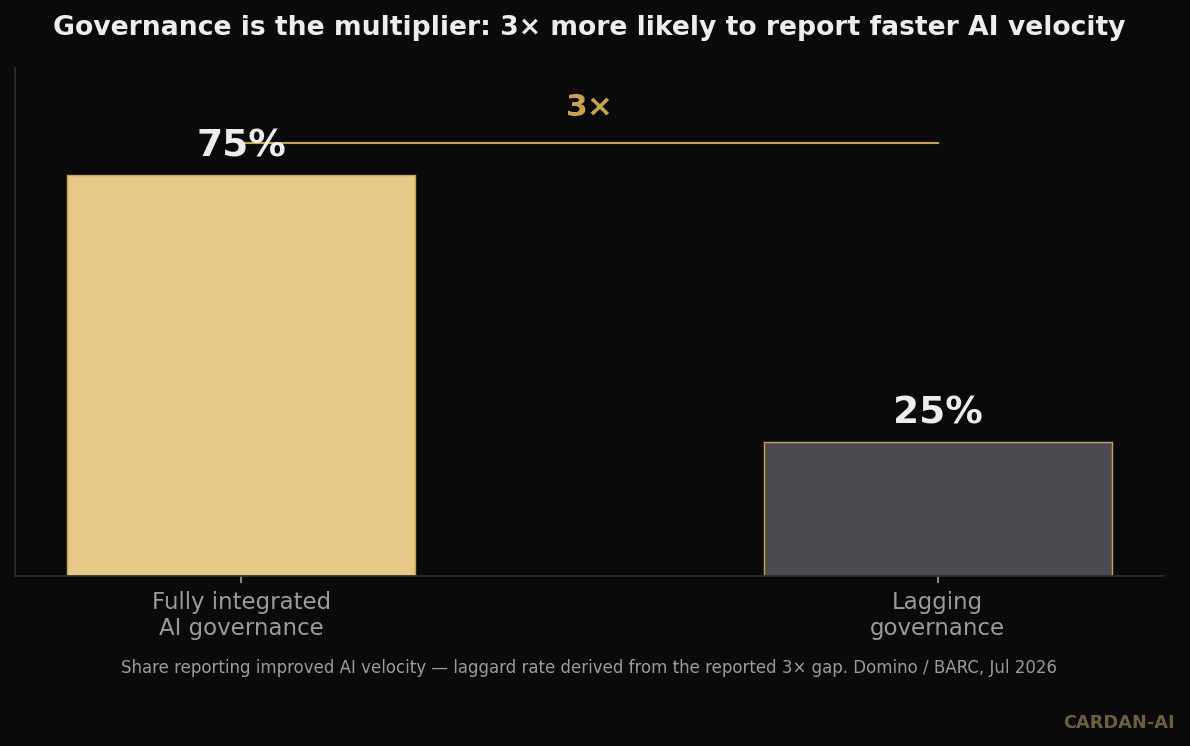
The second finding names the lever. Organisations with fully integrated AI governance are three times more likely to report improving AI velocity than those whose governance lags. That inverts the intuition that governance is a brake. In practice, governance here does not mean paperwork or a committee that says no. It means the operating system that decides which use cases ship, how models are versioned, what the acceptance thresholds are, and when a deployed model is re-validated. It is the machinery that lets an organisation move quickly without moving recklessly.
That is exactly why the finding matters most in regulated, capital-intensive sectors. In aerospace and defence, energy, oil and gas, and luxury or cosmetics manufacturing, the model itself is rarely the differentiator — everyone can buy or fine-tune one. The moat is the certified process wrapped around it: the qualification file, the traceability, the audit trail, the controlled hand-off between a model version and a decision that touches safety, margin or uptime. Firms in these sectors already know how to certify a physical process. The return on AI accrues to those who extend that same discipline to their models instead of running AI in a shadow track outside the quality system.
There is also a subtler economic reason these sectors should move first. The cost of exploiting a decision-support capability you have already funded is close to zero at the margin — the model is bought, the data already flows off the turbine, the line, the well, the filling machine. What blocks the return is not another gigawatt of compute or another pilot; it is the last-mile wiring that connects an existing capability to a decision someone is accountable for. That wiring is a governance and organisational task far more than a technical one, which is precisely why more spend on tooling does not fix it.
So the question to put on the table before the next model purchase is not "what more can AI do?" — the report already answers that: quite a lot, almost everywhere. The sharper question is: which capability we have already paid for is not yet wired into a decision that moves margin, safety or uptime? Map the capabilities you own against the decisions that actually matter, close the loops that governance can make auditable, and the 50-point gap between what AI does and what it earns begins to shrink. In 2026 that gap, not the model leaderboard, is where competitive advantage is decided.
Analysis by
Cardan-AI Intelligence
Our research and analysis unit, dedicated to applied AI for business, industry and regulatory compliance.
Let's talk about your next competitive edge
A 30-minute conversation to identify your most profitable AI use cases.