
AI and Electricity: When Productive Capital Outruns Social Overhead Capital
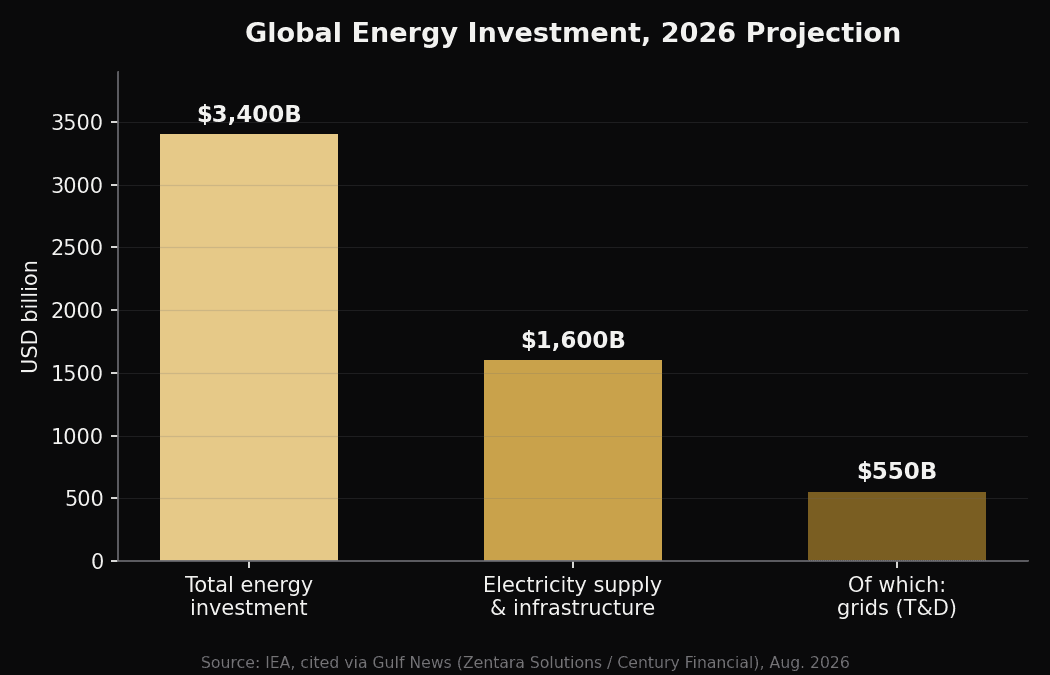
The IEA projects $3.4 trillion in global energy investment for 2026, of which only $550 billion goes to electricity grids, while data center demand is set to double by 2030. An economist's reading: a textbook case of unbalanced growth (Hirschman, 1958), where productive capital outpaces the social overhead capital that makes it deliverable.
Global energy investment figures for 2026, as cited in early August by analysts at Century Financial and Zentara Solutions based on International Energy Agency data, reveal a clear imbalance. Of $3.4 trillion in total investment, $1.6 trillion goes to electricity — generation and infrastructure combined — but transmission and distribution grids, meaning high-voltage lines, substations and interconnection infrastructure, capture only $550 billion. That is roughly 16% of total energy investment and just a third of broad electricity investment.
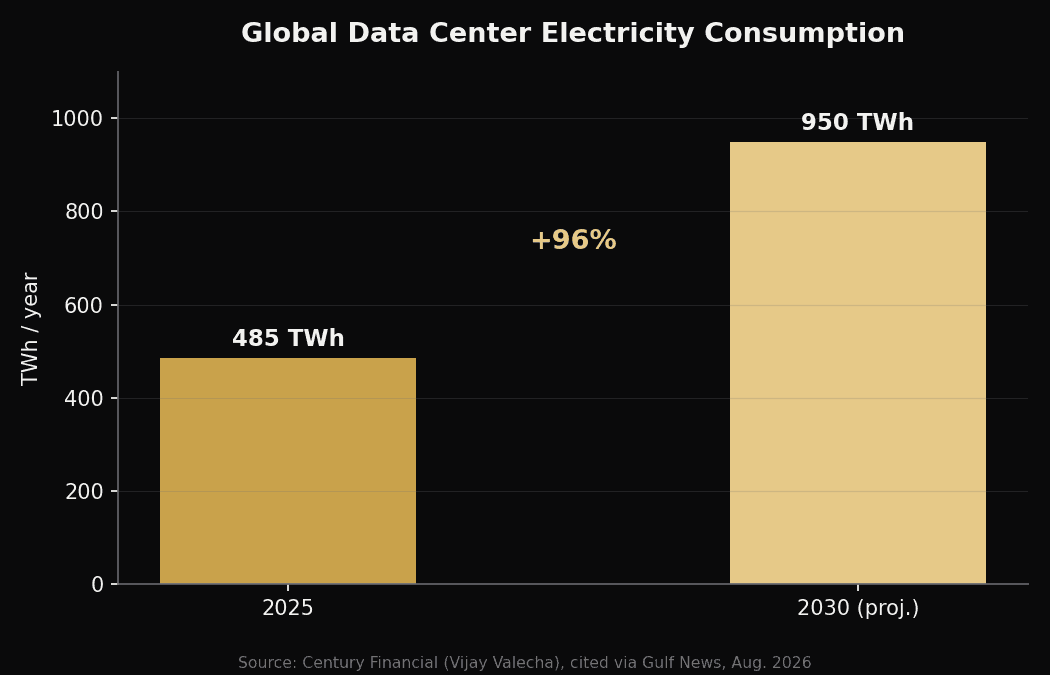
That figure takes on its full meaning alongside a second data point: global data center electricity consumption, driven by AI training and inference, is projected to rise from 485 TWh in 2025 to 950 TWh in 2030 according to the same sources — a 96% increase in five years. The growth rate of AI-driven electricity demand significantly outpaces investment in the infrastructure meant to physically deliver it.
This configuration maps almost term-for-term onto the theory of unbalanced growth formulated by economist Albert Hirschman in 1958. Hirschman distinguished directly productive activities (DPA) — which generate immediate returns and are therefore attractive to private capital — from social overhead capital (SOC), the base infrastructure (roads, ports, networks) that makes those activities possible but whose returns are diffuse, delayed, and often captured by actors other than those who invest. In his model, developing economies advance precisely because capital flows first toward DPA, creating tensions and bottlenecks that, in turn, justify and trigger investment in SOC.
The parallel with AI is direct. Compute facilities and dedicated power generation capacity — including the direct power-purchase agreements hyperscalers are signing with generators — constitute the sector's DPA: fast returns, measurable ROI, private capture of the gain. Transmission and distribution grids constitute the SOC: a quasi-public good, with returns diffused across all connected users, largely financed by regulated or public operators whose incentives and approval cycles move slower than a hyperscaler that can sign a power-purchase agreement in a matter of months.
The history of electrification and telecommunications offers a useful precedent: in both cases, a phase of relative underinvestment in the network relative to demand produced interconnection queues, congestion pricing and, ultimately, a correction through higher prices or regulatory intervention forcing network investment. The time lag between DPA and SOC is not anomalous in Hirschman's model — it is the very mechanism of growth — but it carries a transition cost borne by non-priority grid users during the catch-up phase.
For the sectors Cardan-AI tracks, three operational takeaways stand out. First, electricity availability and price are becoming a siting factor for industrial operations at least as decisive as chip or cloud access, particularly for energy and industrial sites electrifying their own processes alongside AI workloads. Second, players able to secure dedicated power capacity or direct supply agreements — as hyperscalers are doing — gain a temporary competitive edge as long as the general grid remains constrained. Third, investment in social overhead capital (the grid) constitutes, for patient capital, a real option on the medium-term resolution of the bottleneck, in a logic close to the sequenced investment under uncertainty described by Dixit and Pindyck (1994).
The risk, conversely, is planning that treats electricity availability as a given on the same footing as compute power. Industrial, aerospace and energy companies embedding AI into their operations would be well served to treat grid interconnection as a planning constraint in its own right, not a commodity available on demand.
Analysis by
Cardan-AI Intelligence
Our research and analysis unit, dedicated to applied AI for business, industry and regulatory compliance.
Let's talk about your next competitive edge
A 30-minute conversation to identify your most profitable AI use cases.