
The Oil & Gas AI Market: A $25B Projection Says Nothing About Who Will Capture the Value
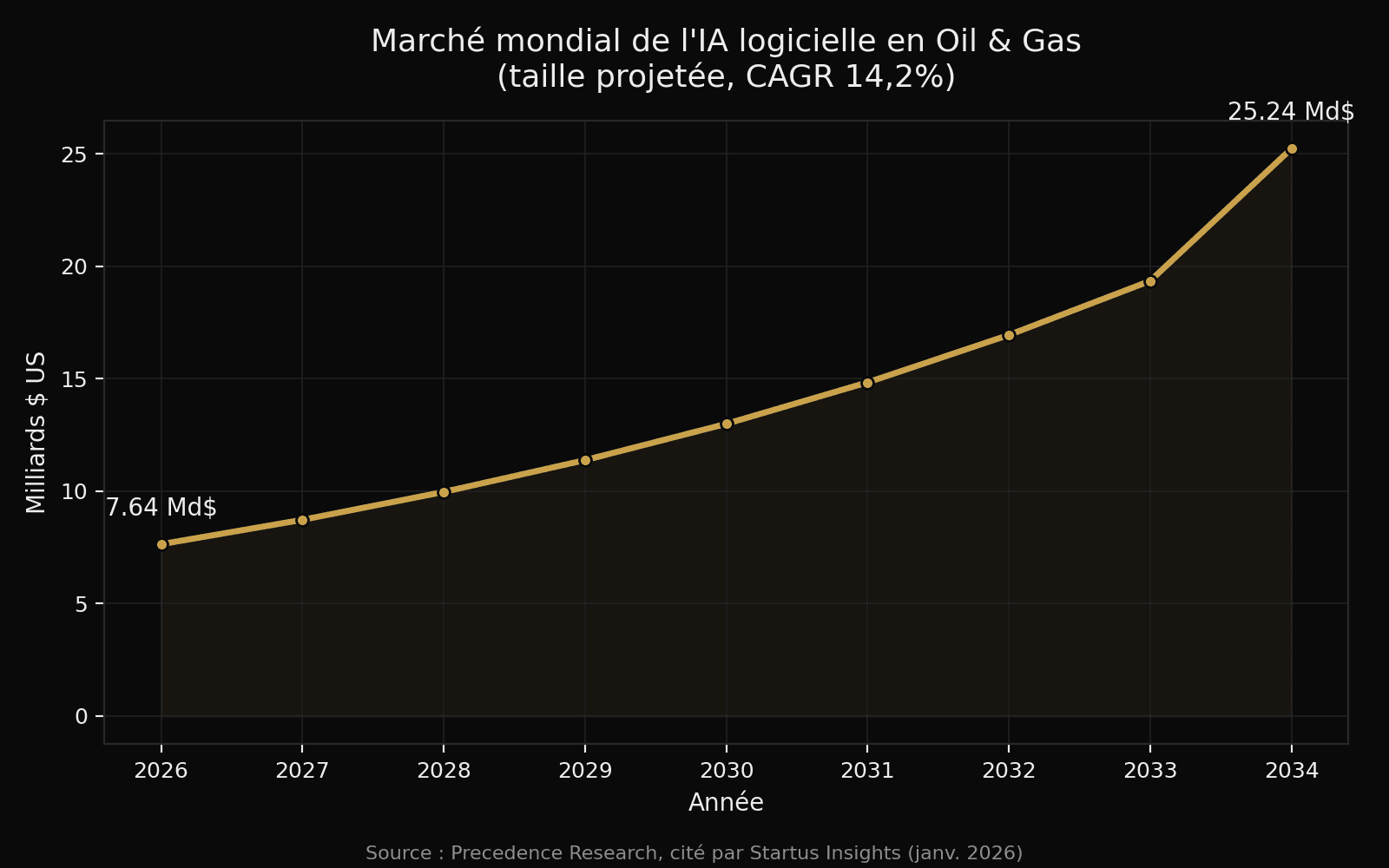
Precedence Research projects the global upstream O&G AI software market from $7.64B (2026) to $25.24B (2034), a 14.2% CAGR. An economist's read: a market-size extrapolation is silent on competitive structure — and therefore on who, between specialized vendors and supermajors internalizing the capability, actually captures the margin.
According to Precedence Research, cited by Startus Insights in its January 2026 overview of the ten startups shaping AI in oil and gas, the global market for AI software applied to upstream oil and gas operations stands at $7.64 billion in 2026. The same source projects it to reach $25.24 billion by 2034 — a compound annual growth rate of 14.2% over eight years, a trajectory that, if realized, would more than triple the market's size.
This kind of figure circulates widely in trade press and investor decks, and it deserves to be taken seriously: demand for machine-learning-assisted drilling optimization, predictive maintenance on critical infrastructure, and augmented seismic analysis is real and documented by the sheer diversity of the ten players surveyed. But a CAGR projection answers only one question — how many dollars will flow through this market — and stays entirely silent on a second, economically far more decisive one: who, within the value chain, will capture that growth as margin rather than merely as pass-through revenue.
This is where a classic economic trade-off applies: build versus buy. As long as a software capability remains peripheral to an oil company's core activity, buying externally from a specialized vendor is rational — the transaction cost and the cost of duplicating expertise outweigh the benefit of internalizing. But once an AI capability becomes strategic — that is, once it directly affects the marginal cost of extraction or the reliability of a critical asset — the theory of the firm (Coase, Williamson) predicts a shift toward vertical integration: the company internalizes, reducing the external vendor to a mere compute-capacity subcontractor with no pricing power left.
Sector majors have historically followed this pattern for other critical technology building blocks — reservoir modeling, proprietary seismic simulation — built in-house or acquired once they proved differentiating. Nothing suggests AI will escape this dynamic; if anything, the cumulative nature of proprietary subsurface and operational data, hard for a third-party vendor to replicate without access to that same data, structurally favors vertical integration over the emergence of dominant independent vendors.
For the ten startups surveyed by Startus Insights, the rational strategy is therefore not to maximize captured market share, but acquisition speed — getting acquired before the client major decides to internalize the capability itself. This is a well-documented pattern in other sectors with fast vertical-integration cycles (semiconductors, enterprise cloud): the independent vendor's rent window is narrow, and it closes with the client's technological maturity, not with the size of the addressable market.
For an investor or an industrial executive, the practical takeaway is to never read a CAGR projection as an opportunity signal in itself. The question to ask is: who in this chain has the least incentive and the least capacity to internalize? Generally, the most generic building blocks, least coupled to proprietary data — regulatory-compliance language processing, training tools, document management — retain rent potential for an external vendor, unlike drilling optimization or seismic analysis, which sit at the core of the majors' intellectual property.
The $25.24 billion figure for 2034 will likely be reached, or nearly so. The real strategic question for Cardan-AI and its energy-sector clients isn't betting on market size, but mapping today which software building blocks will still be bought externally in eight years — and which will already have been internalized.
Analysis by
Cardan-AI Intelligence
Our research and analysis unit, dedicated to applied AI for business, industry and regulatory compliance.
Let's talk about your next competitive edge
A 30-minute conversation to identify your most profitable AI use cases.