
The AI-in-O&G market: when forecaster disagreement is itself the signal
Two research firms publish, weeks apart, CAGRs of 14.2% and 19.47% for the same upstream oil-and-gas AI market. An economist's read: forecast dispersion is a direct measure of market uncertainty, and should govern the pace of capital commitment more than the midpoint of the forecasts.
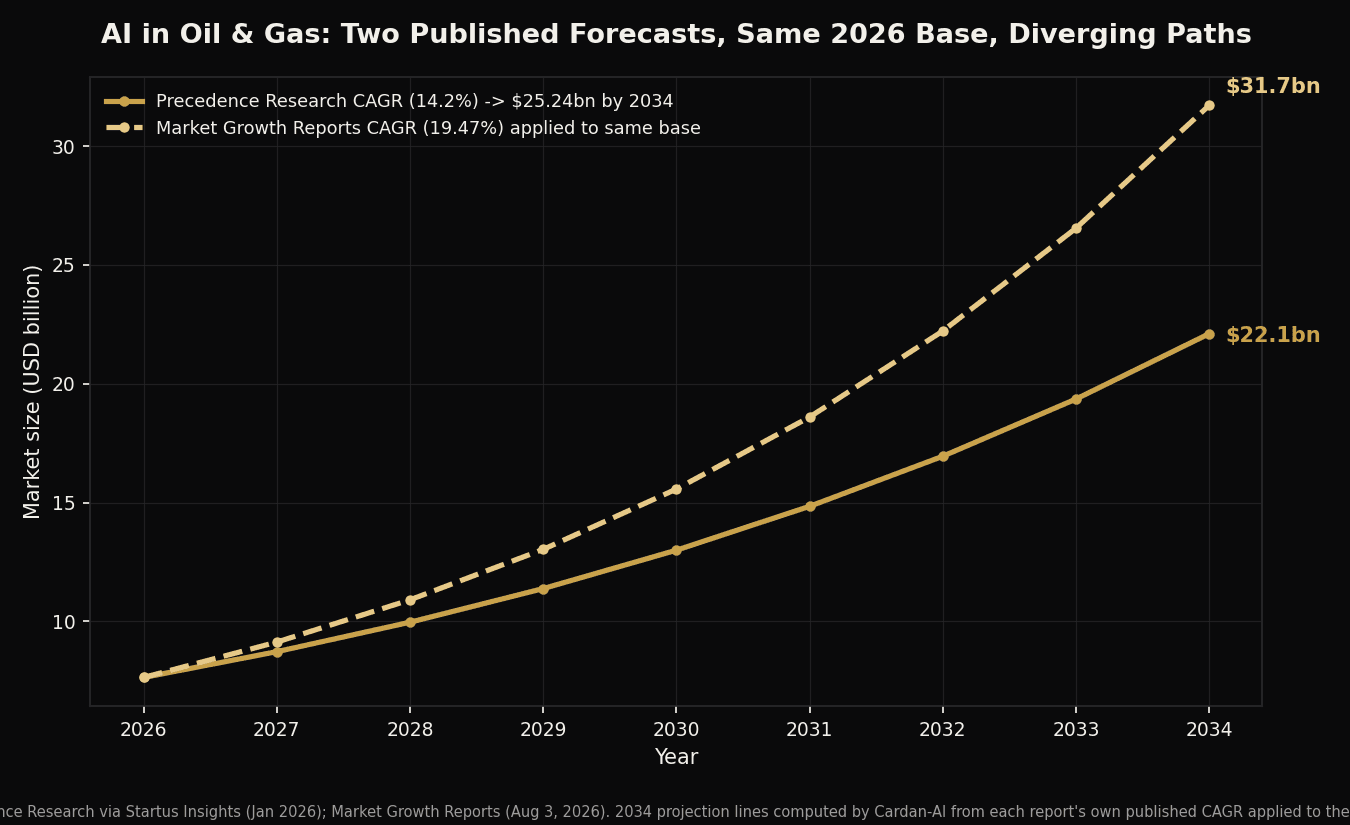
On August 8, 2026, Cardan-AI published an analysis built on Precedence Research's projection: $7.64bn in 2026 for upstream O&G AI software, $25.24bn by 2034, a 14.2% CAGR. On August 3, 2026 — a few days earlier, in fact — Market Growth Reports published its own estimate for a comparable market scope: a 19.47% CAGR over 2026-2035. Applied to the same $7.64bn base, these two growth rates produce trajectories that diverge by more than 50% in relative terms by 2034.
This is not an isolated case. The forecast-combination literature — from Bates and Granger (1969) through to the Bank of England's fan charts or Federal Reserve practice in macroeconomics — starts from a simple observation: when several competent forecasters produce different estimates for the same future quantity, the dispersion between their forecasts is not noise to discard — it is a direct, usable measure of the uncertainty surrounding that quantity. A board that receives a single CAGR figure in an investment memo receives false precision; a board that receives a 14%-to-20% range receives information about risk, not just about expected return.
The problem is compounded by the methodological opacity typical of the AI market-report genre. Neither firm cited here publishes its counting scope in detail: software-only versus a software-plus-services ecosystem, whether pre-existing automation solutions rebranded as "AI" are included, the sample and weighting of surveyed vendors. This opacity makes the published CAGRs look commensurable — two percentages, a 2026-2034/2035 horizon — when they may in fact be measuring different objects. The displayed precision (one decimal place) masks a construction-level uncertainty that the decimal does not capture.
For an investment committee in upstream O&G, the takeaway is not to arbitrate between 14.2% and 19.47% by hunting for the "more reliable" figure, but to recognize that the gap itself sizes the timing risk. A market where two credible studies diverge by more than five CAGR points over an eight-year horizon is a market where the value of waiting for additional information before committing irreversible capital — in the sense of real options theory (Dixit and Pindyck, 1994), already used in our August 6 analysis of the AI Act — is significant. This is not an argument against investing; it is an argument for sequencing investment in tranches conditioned on the progressive resolution of uncertainty, rather than committing a multi-year budget calibrated to a single forecast point chosen among several that contradict each other.
Operationally, this translates into three concrete recommendations for an investment director or CIO at a major or a mid-cap oilfield services firm: first, require market-report vendors to disclose their counting methodology before citing them in an internal business case; second, systematically present a range — not a point — in investment memos submitted to committees, making explicit that the width of the range reflects genuine analyst disagreement rather than a generic error margin; third, structure capital commitments to upstream AI software building blocks as revisable milestones rather than a closed envelope, so deployment speed stays aligned with the speed at which the market itself clarifies its own size.
This piece complements, from a different angle, Cardan-AI's prior sector analyses: the August 8 piece addressed competitive structure (build-vs-buy against a fragile vendor rent); the August 3 piece addressed the physical constraint of firm electrons. This one addresses the quality of the information itself — the precondition for any allocation decision, often treated as given when it is not.
Analysis by
Cardan-AI Intelligence
Our research and analysis unit, dedicated to applied AI for business, industry and regulatory compliance.
Let's talk about your next competitive edge
A 30-minute conversation to identify your most profitable AI use cases.