
AI in oil & gas: why 92% invest but only 50% deploy
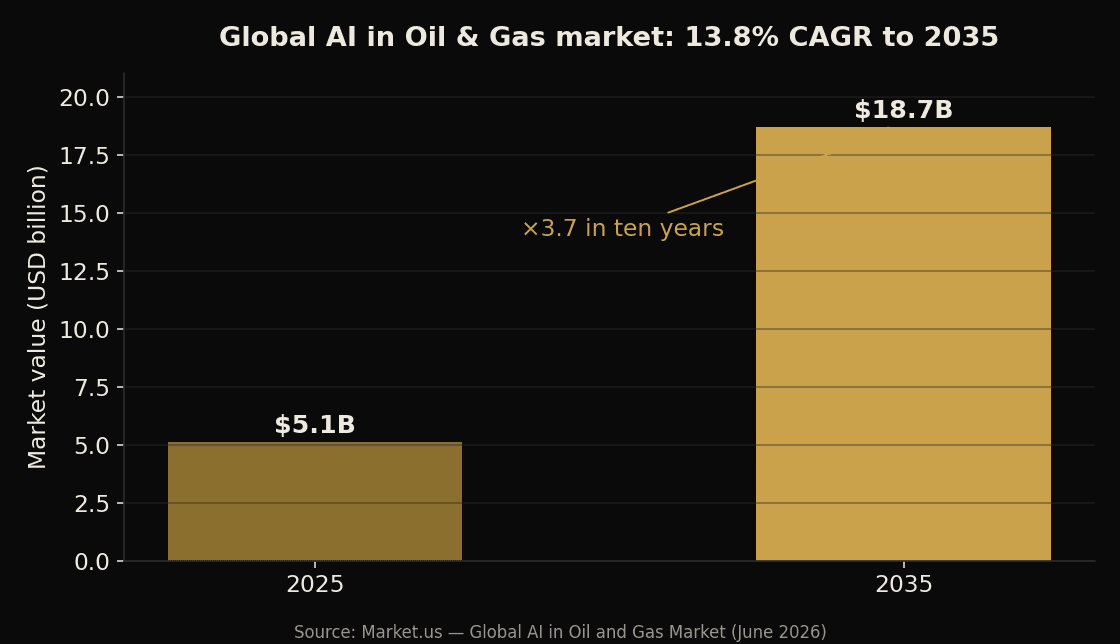
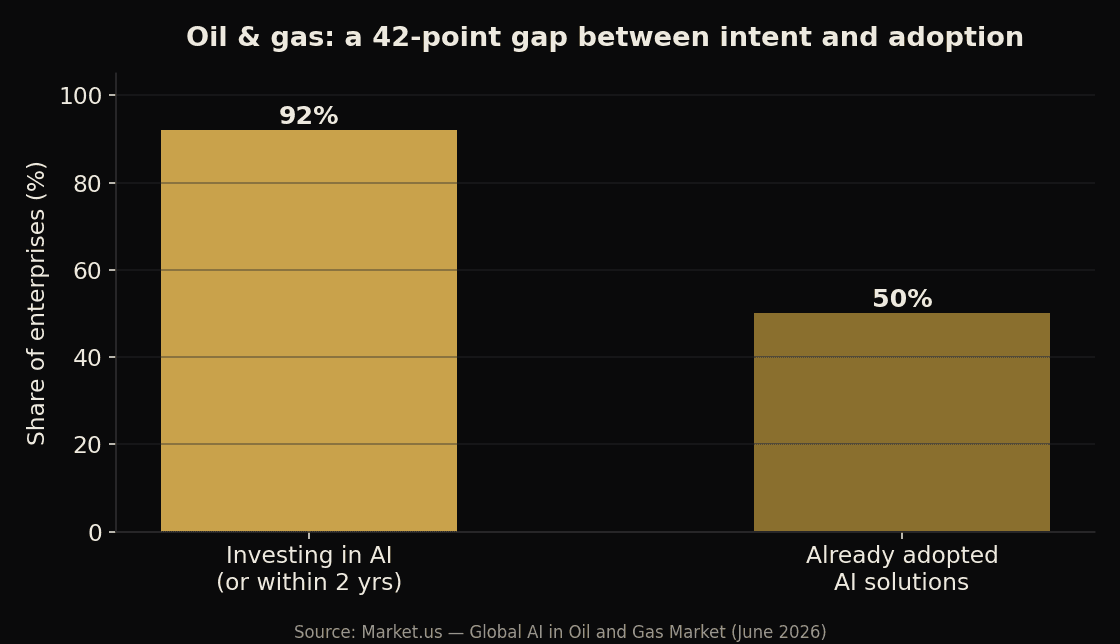
The global AI in oil and gas market triples by 2035 ($5.1B → $18.7B, 13.8% CAGR), yet 92% of enterprises invest while only 50% have deployed and hardware captures 43.4% of spend. An economist's reading: the sector is in the 'installation phase' of a general-purpose technology — capital precedes productivity, and the intent-adoption gap is a timing lag, not a failure.
According to the report published by Market.us in June 2026, the global market for artificial intelligence in oil and gas reaches $5.1 billion in 2025 and is projected to rise to $18.7 billion by 2035, a compound annual growth rate (CAGR) of 13.8%. North America holds 40.6% of it ($2.0B), supported by U.S. output of 13.2 million barrels per day and 113 billion cubic feet of natural gas per day in 2024.
Behind these growth figures lies a tension more instructive than the trajectory itself. The report notes that 92% of sector enterprises invest in AI or plan to within two years, but that only 50% of their executives have actually adopted solutions in production — a 42-point gap between stated intent and effective deployment. At the same time, the spending structure remains dominated by hardware (43.4% of the 2025 market), ahead of software and services, with upstream representing 51.8% of applications and predictive maintenance and equipment inspection 32.4%.
The intuitive reading would see an execution lag, or even operator skepticism. Economic analysis suggests otherwise. AI is not a point application but what Bresnahan and Trajtenberg (1995) termed a general-purpose technology: a cross-cutting building block whose value materializes only through a network of complementary investments — sensors, connectivity, process redesign, skills. Such technologies follow a characteristic timeline, described by Paul David in his celebrated analysis of 'the dynamo and the computer' (1990): infrastructure deploys first, and productivity gains materialize only years later, once the capital stock and usage have matured.
The dominance of hardware in spending (43.4%) is the clearest marker of this phase. A sector already capturing AI's value spends mostly on optimization software and services; a sector preparing that capture spends first on physical infrastructure. Carlota Perez (2002) calls this precise moment the 'installation phase' of a technological paradigm — when capital flows toward building the network, as opposed to the 'deployment phase' where productivity and returns diffuse through the real economy. The 43.4% hardware share and the 92% investment intent describe an industry in full installation.
This framework has a direct consequence for interpreting the intent-adoption gap. If AI were a standalone application with immediate ROI, a 50% deployment rate against 92% intent would signal disappointment or an obstacle. Within a general-purpose technology, the same gap signals a normal timing lag: capacity investment structurally precedes production deployment, which in turn precedes the measurement of gains. Solow's productivity paradox — 'you can see the computer age everywhere but in the productivity statistics' — was not a refutation of computing, but a description of a diffusion lag that the 1990s eventually resolved.
The binding constraint in this phase is therefore not capital — which is flowing — but the set of complementary assets Teece (1986) identified as the condition for value capture: clean, structured data, integration with existing industrial control systems (SCADA, historians), and above all internal skills capable of turning a model into an operational decision. This is where the 42-point gap opens: the firms crossing the threshold into real adoption are not those spending the most on hardware, but those that have built the organizational complements around it.
For an upstream oil and gas executive, the operational conclusion is twofold. First, the sector's intent-adoption gap is no reason to wait: it defines precisely the window of competitive advantage, since the deployment phase — where returns materialize — will first reward those who built the complementary assets during the installation phase. Second, the real governance question is not 'how much to invest in AI' but 'what share of the investment goes to organizational complements rather than hardware alone' — because it is that ratio, not the total amount, that will determine which side of the 42 points a firm lands on by 2035.
Analysis by
Cardan-AI Intelligence
Our research and analysis unit, dedicated to applied AI for business, industry and regulatory compliance.
Let's talk about your next competitive edge
A 30-minute conversation to identify your most profitable AI use cases.