
The AI capex bubble is the supplier's problem — not the buyer's
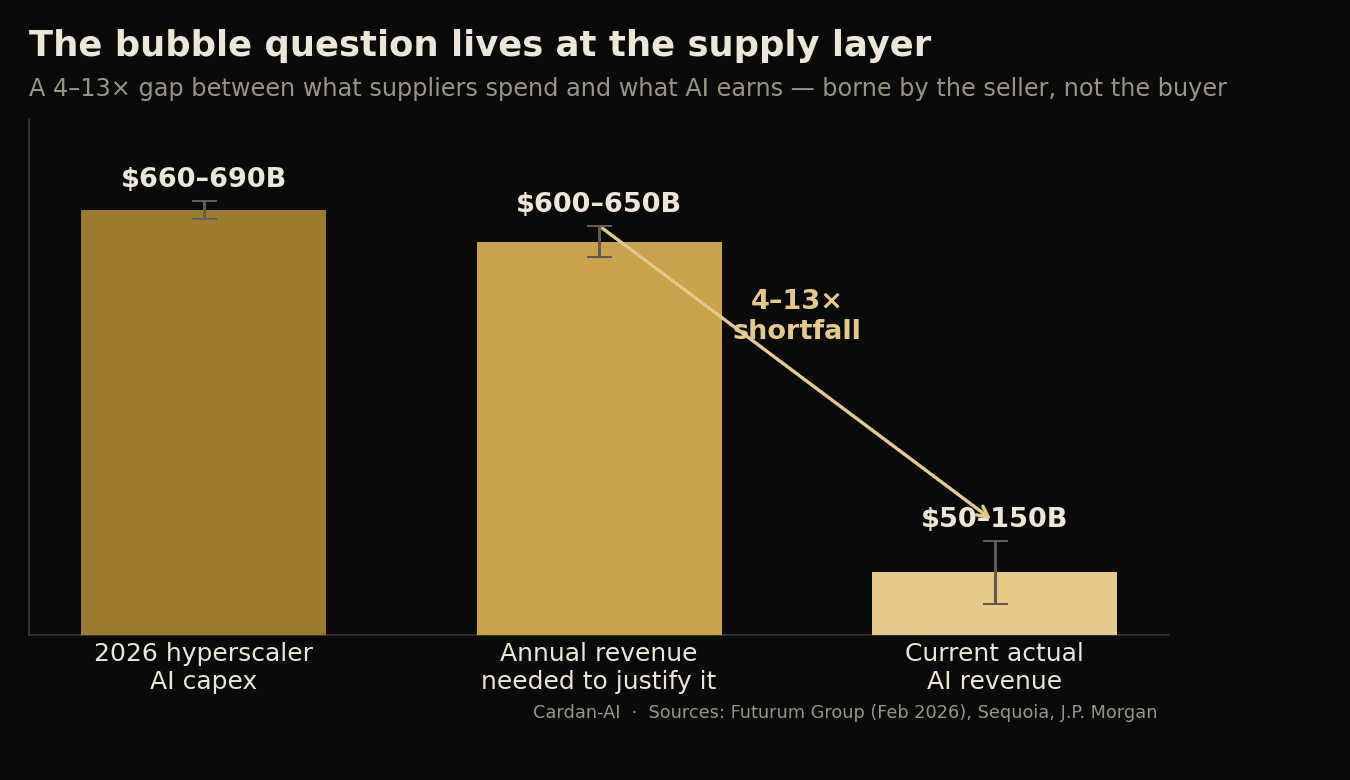
Hyperscalers will spend ~$660-690B on AI infrastructure in 2026 against ~$600-650B of revenue needed to justify it and only ~$50-150B earned — a 4-13x gap. Read as an economist, that bet sits on the supplier's balance sheet, not the buyer's. For regulated, capital-intensive sectors, ROI is decoupled from the frontier race: buy commoditised capability against data you already own, not the capex.
Wall Street has settled on a single question about artificial intelligence: is this a bubble? If you run a fleet, a refinery, a grid or a production line, that is the wrong question to organise your 2026 around — because the bet everyone is arguing about does not sit on your balance sheet.
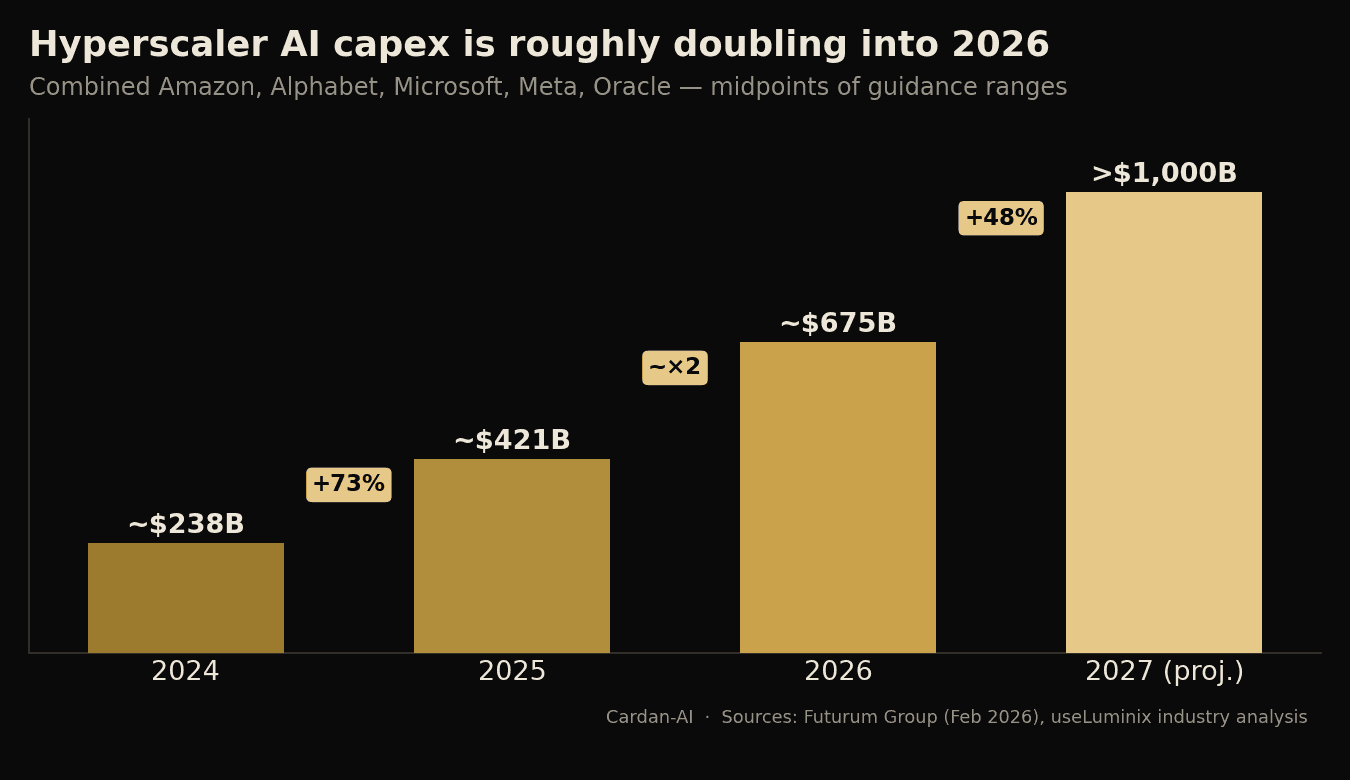
Start with the numbers that fuel the panic, because they are real. Combined hyperscaler AI capex is set to reach roughly $660-690 billion in 2026, close to double the ~$380 billion of 2025, and the trajectory points past a trillion dollars in 2027. Against that build, the annual revenue needed to justify the spend is estimated at ~$600 billion by Sequoia and ~$650 billion by J.P. Morgan. Actual AI revenue today is somewhere between $50 and $150 billion on a generous count. That is a four-to-thirteen-fold gap between what the supply side is spending and what AI currently earns.
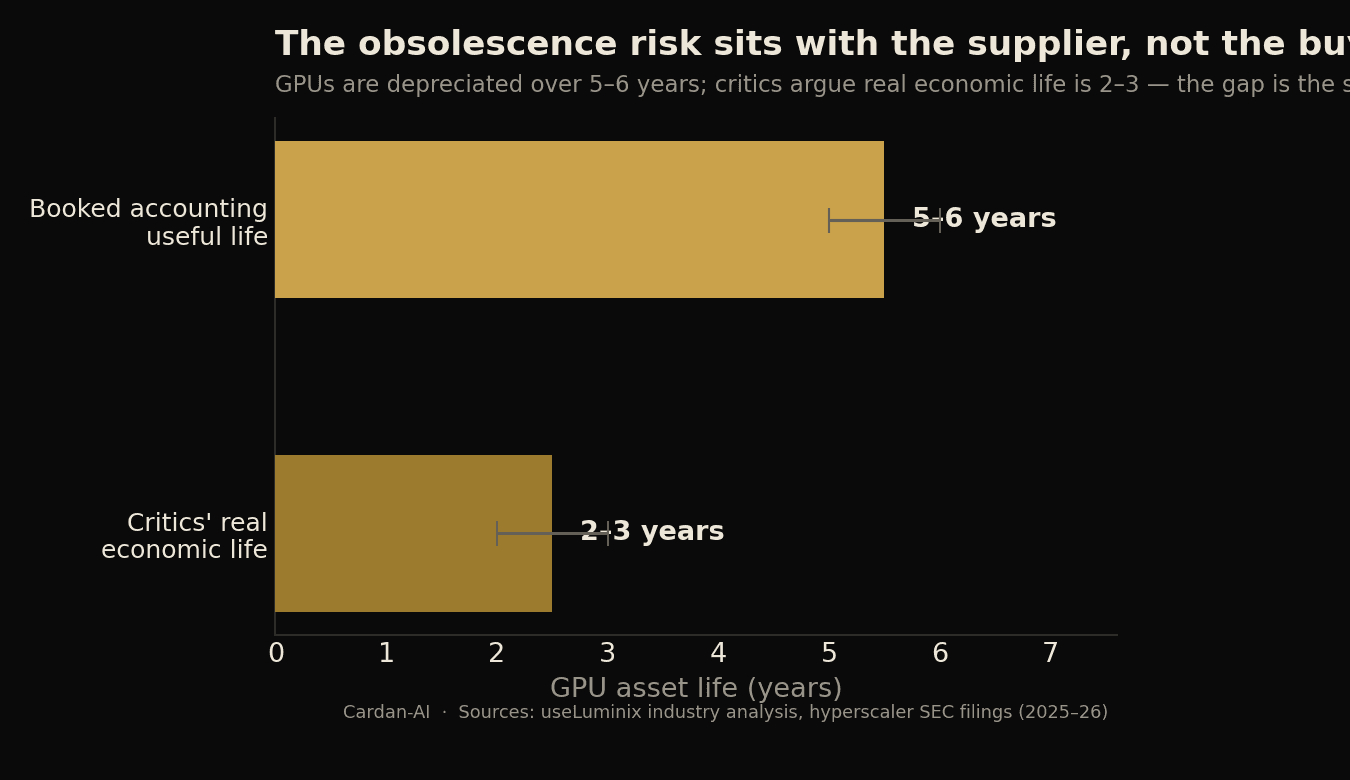
There is an accounting twist that sharpens the worry. Hyperscalers depreciate GPUs over five to six years, yet critics argue the real economic life is closer to two or three given how quickly each Nvidia generation obsoletes the last. On that reading, near-term profits are flattered by tens of billions a year across the industry. The single cleanest leading indicator — quarterly AI revenue only first exceeded quarterly depreciation in Q4 2025 — turned positive just as the asset base is about to roughly double.
Read as an economist, the decisive concept is the incidence of risk: who actually bears it. That bet lives on the supplier's balance sheet — the model labs and the hyperscalers financing the build — not on the deployer's. Whether Nvidia's next chip strands today's silicon, whether OpenAI grows into a $600 billion revenue base, changes nothing about the return on your predictive-maintenance model or your quality-control vision system. Your project ROI is not priced by whether the model layer clears its own hurdle rate.
In fact the dynamic runs in the buyer's favour. Fierce supply competition and fast obsolescence do to capability prices what they always do to a commoditised input: they push them down. Inference and model access get cheaper each quarter, while the proprietary data you already hold — formulation records, sensor histories, maintenance logs, quality dossiers — appreciates because it is scarce and non-rentable. Your input cost curve bends down over time while your true asset compounds. The option value of waiting is low precisely because both trends favour you.
So the move for regulated, capital-intensive sectors — aerospace and defence, oil and gas, energy, luxury and cosmetics — is to decouple the AI strategy from the frontier arms race. Do not buy the narrative and do not buy the capex; buy the outcome. Map the data you already own against the decisions that move margin, safety and uptime, then deploy now-commoditised models against that map. The first euro of return comes from the map, not the GPU — and it is indifferent to who wins the model race.
This is where regulated industries hold an underrated edge. The thing that makes deployment safe at scale — safety cases, certification, traceability, version control, acceptance thresholds — is the discipline these sectors already run for their physical assets. A capex glut on the supply side turns the deployment era into a buyer's market for exactly the organisations equipped to govern models the way they already govern turbines and airframes. The bubble question is a macro spectator sport; the buyer's discriminant is deployment discipline, and that is entirely within your control.
Analysis by
Cardan-AI Intelligence
Our research and analysis unit, dedicated to applied AI for business, industry and regulatory compliance.
Sources
- Futurum Group — AI Capex 2026: The $690B Infrastructure Sprint (Nick Patience, 12 Feb 2026): combined hyperscaler AI capex ~$660-690B in 2026 vs ~$380B in 2025; Amazon ~$200B, Alphabet ~$175-185B, Microsoft $120B+, Meta $115-135B, Oracle ~$50B; pure-play AI vendor revenue combined <$35B
- Sequoia Capital — "AI's $600B Question" (2024, updated 2026): ~$600B of annual end-user revenue needed to justify the AI infrastructure buildout
- useLuminix — How much revenue is required to justify the AI capex buildout (industry analysis, 2026): 2026 hyperscaler capex $660-775B; revenue hurdle ~$600B (Sequoia) / ~$650B (J.P. Morgan) vs ~$50-150B actual AI revenue (4-13x gap); GPU accounting life 5-6y vs real economic life 2-3y; quarterly AI revenue first exceeded quarterly depreciation in Q4 2025
Let's talk about your next competitive edge
A 30-minute conversation to identify your most profitable AI use cases.