
Aerospace & Defense: Why Commercial AI Is Accelerating While Military Decision AI Waits
Engine aftermarket revenue grew 20-40% in Q1 2026 on predictive-maintenance AI, while the Department of War's FY27 budget names trusted deployment — not model capability — as the real constraint on military autonomy. An economist's read: two AI speeds reflect two radically different verification-cost structures.
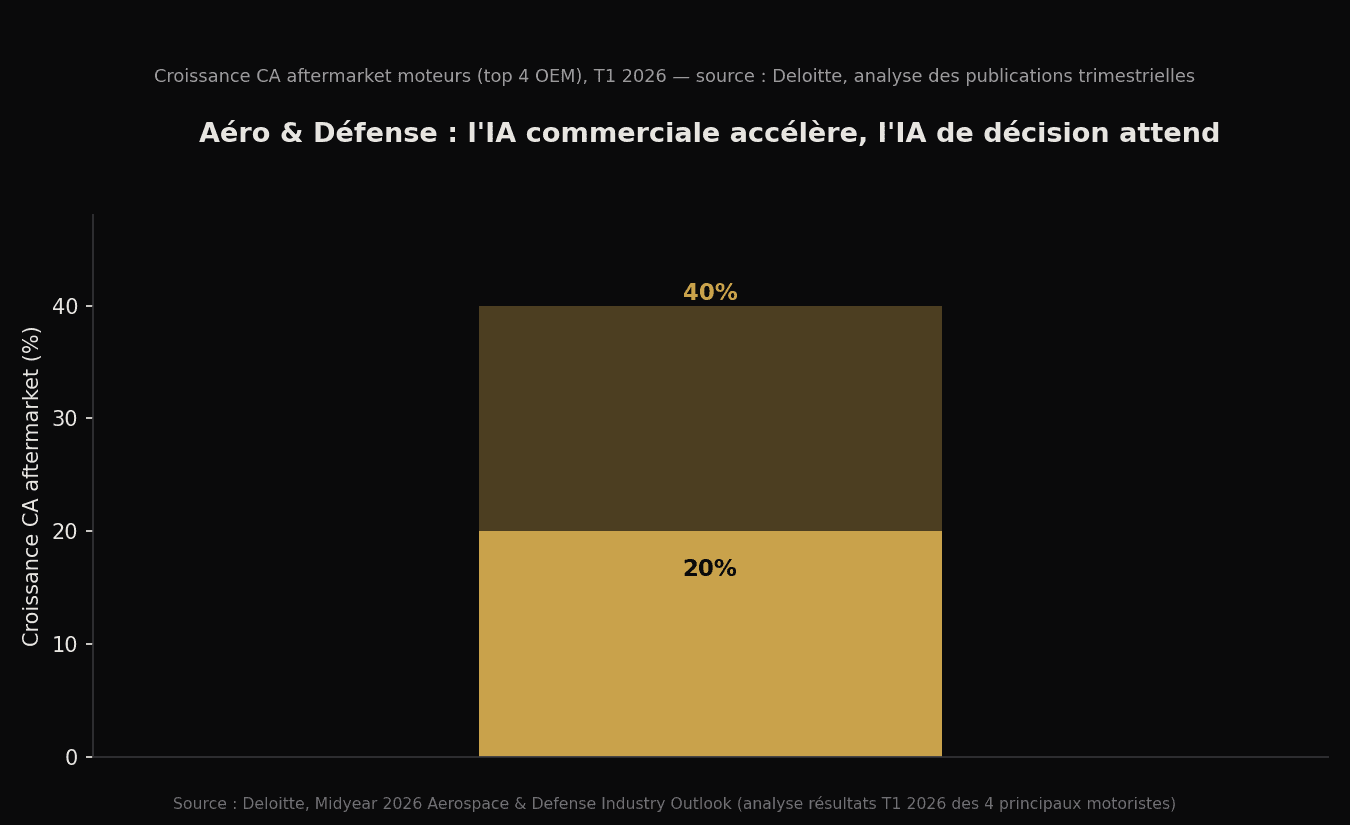
Two publications released weeks apart inadvertently sketch a natural experiment on AI diffusion within a single industrial sector. On one side, Deloitte's midyear update to its 2026 Aerospace and Defense Industry Outlook finds that the top four engine OEMs' aftermarket revenue grew 20% to 40% in Q1 2026, driven by predictive maintenance and digital twins. On the other, the Department of War's FY27 Budget Overview Book, released April 20, 2026, states that the constraint on military AI is no longer model capability but 'trusted deployment at scale.' Two speeds, one sector, one underlying technology.
The explanation lies less in the technology than in the structure of the verification problem. In predictive maintenance, the feedback loop is short and unambiguous: a sensor flags an anomaly, the part is inspected or replaced, and the outcome — avoided failure or false alarm — is observable within weeks. The cost of an error is bounded and known: an unnecessary maintenance intervention costs the price of that intervention. That is precisely the setup an economist recognizes as favorable to fast learning: dense information, quick feedback, small and symmetric error costs.
Autonomous decision-making in a military context has the opposite structure. Feedback is rare — an autonomous detection or engagement system can operate for months without a single real-world event that verifies whether a critical decision was correct. The cost of an error, meanwhile, is potentially catastrophic and irreversible: a false identification or a flawed decision in a conflict zone is not a cost line — it is an existential risk to the operation and to the program's legitimacy. Under that asymmetry, decision theory requires a far higher caution premium than applies to maintenance — and therefore a structurally slower deployment pace, regardless of how mature the underlying model is.
The FY27 budget explicitly reflects this diagnosis by redirecting effort: human-machine governance, certification, decision traceability. The Department of the Air Force's April 2026 decision to invest in an AI talent strategy — a dual-track technical career model, force-wide AI literacy — is not incidental. It is an investment in exactly the human capital needed to lower the verification cost that is holding back deployment. This is not a technology choice; it is an institutional-infrastructure choice.
This diagnosis also illuminates the venture-capital paradox in defense tech: $19.8 billion invested in Q1 2026 (PitchBook, +146% year-over-year), nearly a third of it in autonomous systems. That capital finances capability — in the sense the Department of War used before its own diagnosis shifted — but cannot, by construction, accelerate trusted deployment, which depends on certification cycles, operational doctrine, and acceptability, not funding. The gap between available capital and deployed capacity we documented on August 4 regarding the inelastic industrial base finds a second explanatory mechanism here: it is not only production capacity that is inelastic — verification capacity is too.
For an aerospace & defense manufacturer — or, by extension, any critical-infrastructure operator facing high-error-cost AI decisions (O&G, energy, healthcare) — the economic lesson transfers directly. The AI roadmap should not be prioritized by technical ease of implementation, but by verification cost: use cases with short feedback loops and bounded error costs (maintenance, quality, planning) should be prioritized first — not because they are technically simpler, but because they convert investment into measurable value faster. Critical-decision use cases with rare feedback require prior investment in trust infrastructure — governance, traceability, training — before the model itself is even on the table.
That is a useful reversal of the prevailing AI narrative, which tends to center on model performance. The 2026 bottleneck is, for the most part, no longer in the lab. It is in the organization.
Analysis by
Cardan-AI Intelligence
Our research and analysis unit, dedicated to applied AI for business, industry and regulatory compliance.
Let's talk about your next competitive edge
A 30-minute conversation to identify your most profitable AI use cases.