
Agentic AI in industry: why 36% of potential doesn't mean 36% of adoption
Deloitte puts 36% of industrial manufacturing tasks within reach of agentic AI augmentation — a technical figure, not an adoption rate. The gap between the two is explained by task economics and complementary assets, not a cyclical lag that closes on its own.
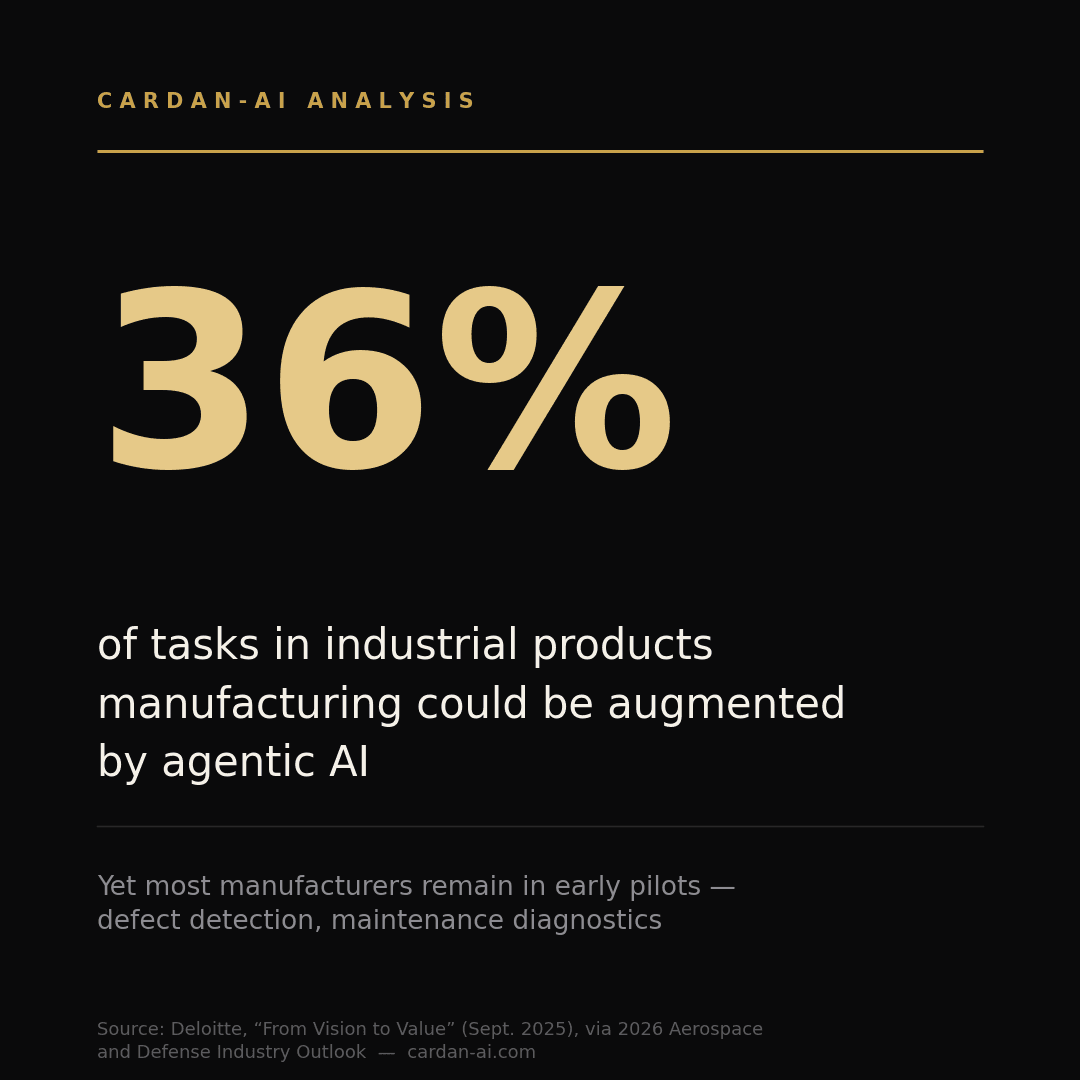
Deloitte's “From Vision to Value” report (September 2025), cited in its 2026 aerospace and defense industry outlook, puts a precise number on the opportunity: 36% of tasks performed across industrial products manufacturing could be augmented by agentic AI. The very next line of the same report notes that most aerospace and defense manufacturers remain stuck at isolated pilot programs — defect detection, maintenance diagnostics — far from production-line-wide deployment. These two figures do not measure the same thing, and conflating them is the single most common misreading in the public debate on enterprise AI.
The first figure is a task-level technical potential. It sits squarely within the framework Autor, Levy and Murnane laid out in 2003: a job is not an atomic unit, it's a bundle of heterogeneous tasks, and any given technology automates some tasks while leaving others untouched. A quality engineer, a maintenance technician, a line operator each perform a mix of codifiable routine tasks, contextual judgment tasks, and relational tasks. Saying “36% of tasks are augmentable” says nothing about how fast that augmentation will translate into measured productivity gains, nor how many organizations will actually have implemented it in one, two, or five years.
The second figure — real adoption, still at the pilot stage — is the one that matters for near-term value creation. And the gap between technical potential and actual deployment isn't an anomaly: it's the standard signature of what Paul David (1990, the “dynamo and computer” analogy) and Carlota Perez (2002) call the installation phase of a general-purpose technology — the period when the technical capability already exists but organizations haven't yet reconfigured their processes, data, and skills around it. Cardan-AI documented the same pattern in upstream oil & gas on August 24 (92% of companies investing, only 50% having deployed): the intention-adoption gap isn't a lag that closes automatically — it's a phase.
What determines how fast that phase resolves is complementary assets in David Teece's (1986) sense: proprietary data infrastructure, workflows redesigned around the agent rather than around the human, risk governance suited to an AI that acts rather than merely suggests. In aerospace and defense, those complementary assets are especially costly to build because the sector stacks two constraints rarely found together elsewhere: certification and traceability requirements that slow any automation of action (beyond mere recommendation), and a legacy installed base that is poorly instrumented. It's the same friction Cardan-AI described on August 18 regarding the race between AI spending (3.5x by 2029, per IDC) and available data skills (from 3% to just 5% of data-science job postings between 2025 and 2028): the bottleneck isn't the model, it's the organization that has to be built around it.
A second theoretical lens completes the picture: Acemoglu and Restrepo (2019) distinguish the displacement effect of automation (routine tasks shift from humans to machines) from its reinstatement effect (new tasks emerge, often in supervision, error correction, or designing the agents themselves). The 36% figure says nothing about this second effect — how many new tasks will the spread of agentic AI create in oversight and correction? — yet it's precisely that second effect that will determine whether the net impact on skilled industrial employment is positive or negative. The Lightcast data Deloitte cites (rising data-analysis and data-science postings) is an early, still-faint signal of that reinstatement already underway.
The practical implication for an industrial executive isn't to wait for technical potential to mechanically translate into competitive advantage, nor to rush into a generic “agentic AI plan.” It's to map, task by task rather than job by job, where technical feasibility and the cost of building the necessary complementary assets (clean data, risk governance, process redesign) actually intersect — then sequence investment where that cost is already lowest, rather than where the headline potential is highest. That's a capital-allocation problem under organizational uncertainty, not a model-selection problem.
This diagnosis matches a pattern Cardan-AI has tracked for several weeks across every regulated industrial sector it follows — energy, oil & gas, aerospace, defense: AI's technical potential almost always runs ahead of its organizational translation, and the gap closes at the pace complementary assets get built, not at the pace models improve.
Analysis by
Cardan-AI Intelligence
Our research and analysis unit, dedicated to applied AI for business, industry and regulatory compliance.
Let's talk about your next competitive edge
A 30-minute conversation to identify your most profitable AI use cases.