
Aerospace & Defense: Does the Record $45B Capex Lock In the Wrong Capacity?
AIA puts 2025 US aerospace & defense capex at $45B, up 13%. An economist's read: a record capex figure tells you the industry intends to invest and nothing about where — and "putty-clay" investment theory shows why that choice, once capital is installed, locks the sector in for a decade.
The Aerospace Industries Association (AIA), with S&P Global Market Intelligence, published the 2026 edition of its annual "Facts & Figures" report on June 25, 2026, covering 2025 data for the US aerospace & defense industry. The headline numbers are striking: $988.6 billion in combined member-company revenue ($1 trillion in total economic activity including the broader supply chain), 2.1 million jobs supported (930,000 direct, 1.1 million in the supply chain), average wages 40% above the national average, and a direct contribution of $500 billion to US GDP — 1.6% of the total.
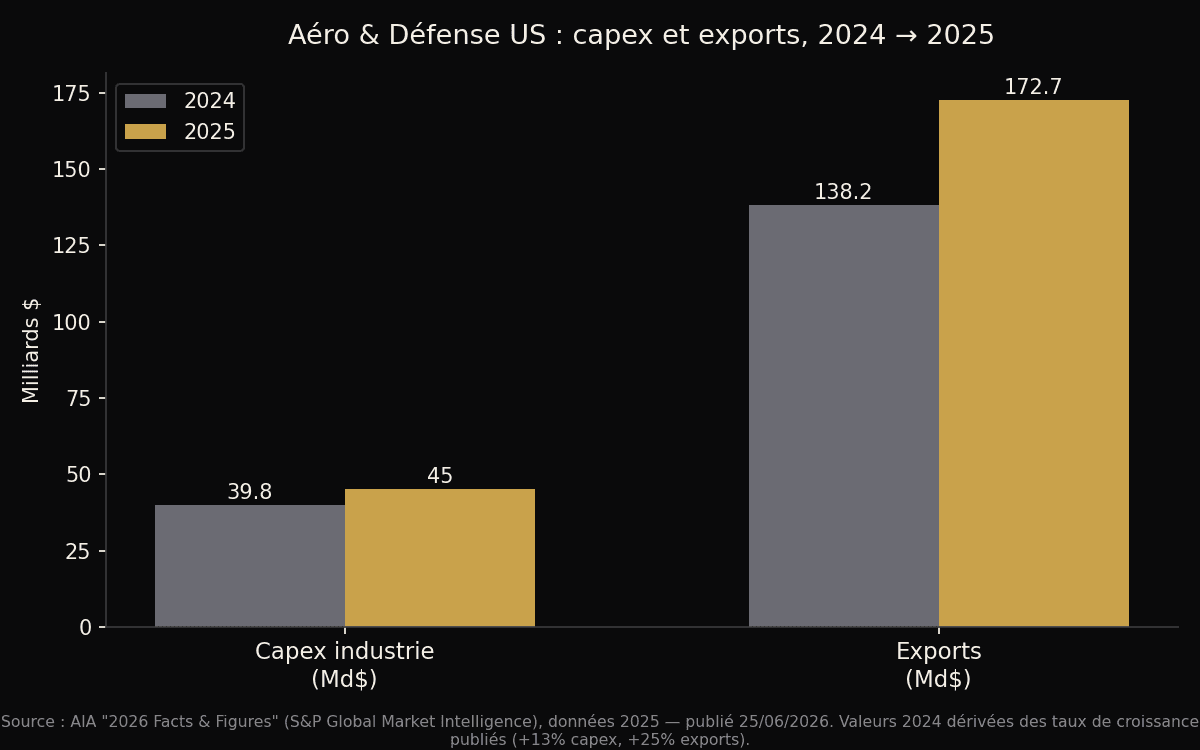
Two figures stand out. First, exports, up 25% year-over-year to $172.7 billion, pushing the sector's trade surplus to $109.2 billion — the largest of any US manufacturing sector, ahead of automotive, pharmaceuticals, or consumer electronics. Second, and the focus of this analysis, capital expenditures, up 13% year-over-year to $45 billion — roughly $39.8 billion in 2024 by our calculation from the published growth rate.
A 13% capex increase looks, on its face, like an unambiguous signal: the industry is investing in its own future, backed by a trade surplus that gives it the financial means to do so. But the AIA report, like nearly every sector publication of this kind, aggregates capex without breaking it down by asset type. The $45 billion figure says nothing about the split between conventional capacity expansion — more assembly lines, more machining centers, more physical production floor — and AI-native capacity: digital twins of production lines, predictive-maintenance systems built on structured proprietary data histories, automated verification platforms for autonomous systems.
That distinction is not cosmetic; it sits at the center of the diagnosis Cardan-AI has been building on this sector over the past several weeks. On July 29, we documented that aerospace & defense's first AI battleground had shifted from production itself to procurement and the supply chain (85% of surveyed executives citing sourcing versus 63% for production, per the data cited at the time). On August 7, we showed that the deployment-speed gap between commercial-engine predictive maintenance (aftermarket revenue growth of 20-40% in Q1 2026) and military decision autonomy (held back, per the Department of War, by large-scale trusted deployment rather than model capability) traced to a radically different verification cost structure between the two use cases. In both cases, the bottleneck had shifted from physical to software, data, and verifiable trust — not raw production capacity.
This is where an old but still operative theoretical framework applies: the "putty-clay" investment model, formalized by Norwegian economist Leif Johansen in 1959 and developed further by Solow and others. The core idea: at the moment of the investment decision, capital is "putty" — malleable, still capable of being directed toward different combinations of production factors. But once capital is physically installed — an assembly line built, a machining center ordered and commissioned — it becomes "clay": rigid, locked into its initial technical configuration, costly to reconfigure. The window of malleability closes at the exact moment the money is spent.
Applied to US aerospace & defense's 2025 capex, this framework has a direct implication: if a meaningful share of the $45 billion funds conventional capacity rather than AI-native capacity, that allocation does not mechanically correct itself the following year through a simple flow adjustment. It locks in the sector's production structure for the coming decade, at precisely the moment our own analysis indicates the binding constraint has moved elsewhere. A sector that invests heavily in conventional "clay" while its competitive problem lives in software and verification would be taking on a strategic obsolescence risk — not because it isn't investing enough, but because it may be investing the right amount in the wrong direction.
The AIA report cannot settle this question, for lack of a capex breakdown by asset type — and that gap is the point to flag rather than paper over with assumption. Cardan-AI's takeaway is as methodological as it is strategic: any industry leader in this sector should demand that internal breakdown before celebrating a capex increase as a signal of strategic health. A record capex figure is unconditionally good news only if its composition is known; otherwise, it is an aggregate number that conceals the more important question.
Analysis by
Cardan-AI Intelligence
Our research and analysis unit, dedicated to applied AI for business, industry and regulatory compliance.
Let's talk about your next competitive edge
A 30-minute conversation to identify your most profitable AI use cases.