
Aerospace & defense: AI's first job is procurement, not the cockpit
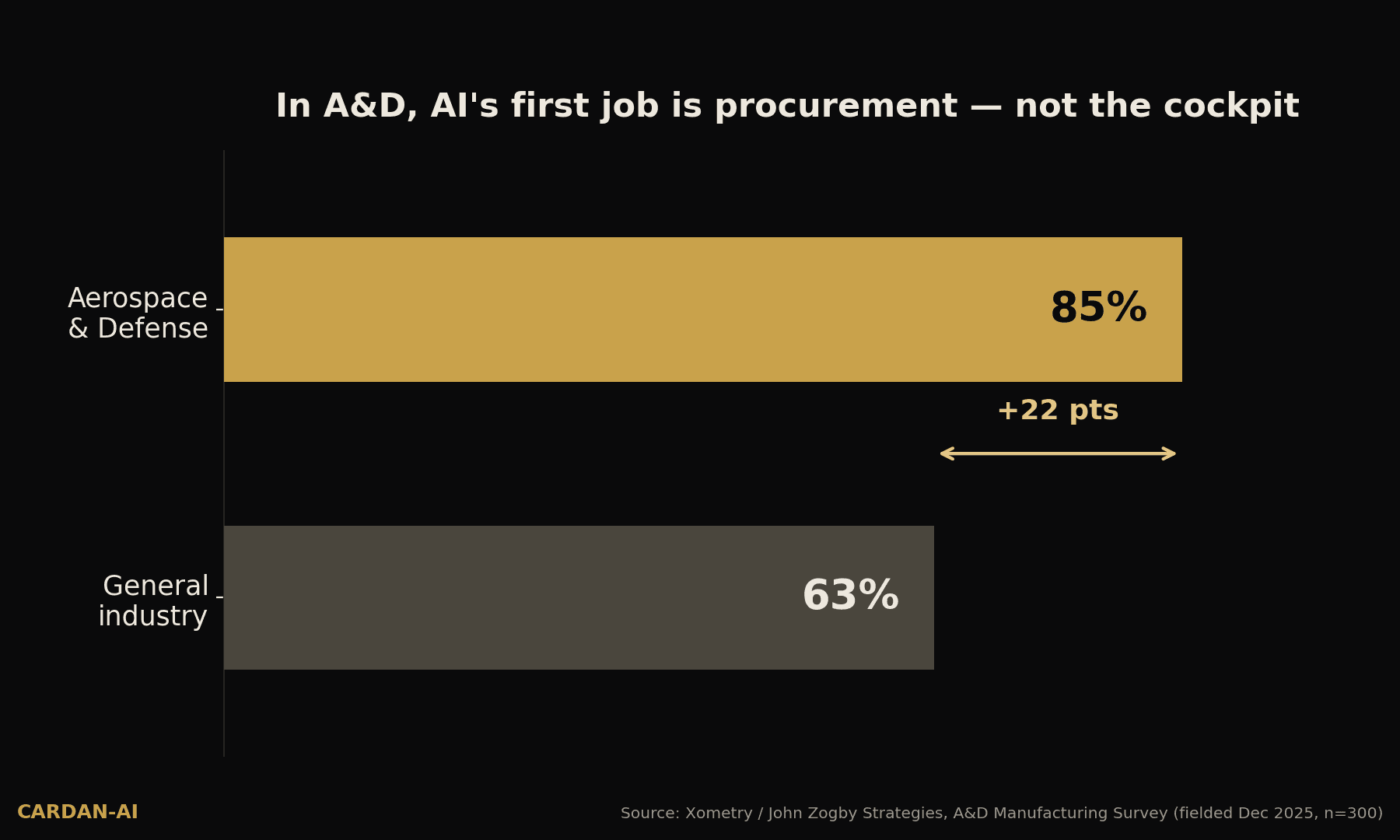
85% of aerospace & defense leaders now prioritize AI for sourcing and procurement — 22 points above general industry — because the binding constraint on program growth is qualified, compliant supply, not model performance. Read as an economist, the highest-ROI AI project shortens supplier qualification and automates traceability, and the sector's compliance discipline is the very moat that makes it deployable.
The headline question in aerospace and defense AI is almost always about the aircraft: autonomous wingmen, AI copilots, GPS-denied navigation. The money is moving somewhere far less cinematic. In a December 2025 survey of 300 manufacturing leaders — 51% of them from aerospace and defense — run by Xometry with John Zogby Strategies, 85% of A&D leaders said they are prioritizing AI-driven sourcing and procurement tools, 22 points above the 63% seen across general industry. The first industrial-scale AI job in this sector is buying, qualifying and tracing parts, not flying them.
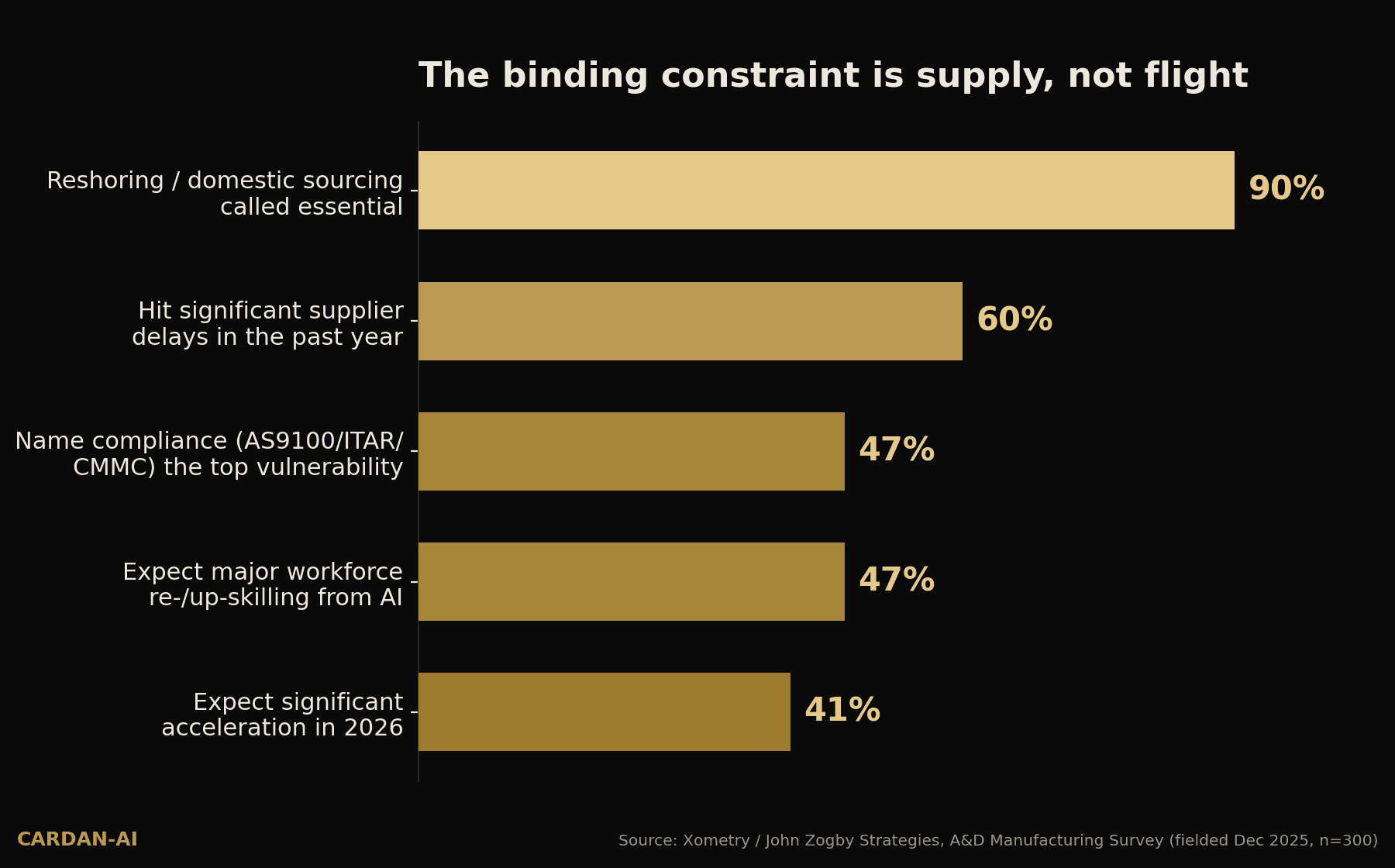
Read as an economist, that is a statement about where the binding constraint sits. A program's throughput is set by its scarcest input, and in A&D that input has not been model performance for some time — it has been qualified, compliant supply. In the same survey, 60% of organisations reported significant supplier delays in the prior year, 90% called reshoring and domestic sourcing capacity essential to success, and 47% named regulatory and quality compliance — AS9100, ITAR, CMMC — their single biggest supply-chain vulnerability. When the queue forms at procurement and qualification, that is where the marginal dollar of AI earns its highest return.
The return on an AI project is not the sophistication of the model; it is the value of the decision it accelerates, multiplied by how often that decision actually binds. A model that shaves weeks off supplier qualification, or that auto-assembles the traceability dossier an AS9100 audit demands, acts directly on the constraint — it widens the bottleneck. A model that improves an already-certified flight function acts on a part of the system that was not the limiting factor. Same spend, very different marginal product. That is why 85% cluster on sourcing rather than autonomy: leaders are, correctly, spending where the shadow price is highest.
The 47% naming compliance the top vulnerability is usually read as a complaint. It is also a description of a moat. AS9100, ITAR and CMMC impose documentation, traceability and change-control discipline that slows everyone down — but that same discipline is exactly what makes an AI deployment auditable, and therefore defensible in front of a regulator or a program office. The audit trail, the versioned decision log, the acceptance threshold: a less-regulated manufacturer has to build all of it from scratch to deploy AI safely, while an A&D supplier already runs it for the airframe. The compliance carried as a cost is the reason A&D can put AI inside a regulated workflow when a consumer-goods competitor cannot.
The 90% calling reshoring essential is not a separate story — it is the same story under geopolitical pressure. Reshoring means re-qualifying suppliers, standing up new domestic sources, and re-running the compliance paperwork for each of them, at speed, against program deadlines. That is a documentation-and-qualification problem before it is a manufacturing one, and it is precisely the workload AI-driven sourcing is being bought to compress. The 85% and the 90% are one decision seen from two angles: the supply base is being rebuilt, and the qualification cost of rebuilding it is what leaders are trying to automate.
The 47% expecting significant re- and up-skilling tells you the shift is organisational, not merely technical. The scarce capability is no longer 'can we run the model' — foundation models are commoditising by the month — it is 'can our buyers, quality engineers and program managers fold AI outputs into a certified process without breaking the certification.' That is a people-and-process investment, and it is where most of the value leaks when it is skipped. A tool bought without the workflow around it produces faster documents that no auditor will accept, which is negative ROI dressed as progress.
For a mid-sized supplier — a French ETI machinist, a composites shop, an electronics subcontractor in the aerospace or defense chain — the lesson is not to chase the flight use case the primes are demoing. It is to look at the sourcing and qualification decisions already inside the business: which supplier approvals, which non-conformance investigations, which traceability dossiers consume the most calendar time and the most senior-engineer hours, and which of those already run on data the company holds today — ERP records, quality logs, certificates of conformity. The first euro of ROI is that map, not a GPU cluster.
The Cardan-AI read: treat AI in aerospace and defense as a supply-chain instrument first. Map the decisions that actually move margin, schedule and compliance risk; identify the ones already instrumented by data you own; and build the governed workflow — audit trail, human checkpoints, acceptance thresholds — around the highest-value one before writing a line of model code. The sector's compliance burden is not the obstacle to this; it is the head start. In a market where 85% of leaders have already concluded that procurement, not the cockpit, is where AI pays first, the competitive question is no longer whether to deploy, but whether you can deploy inside your own certification faster than the supplier next door.
Analysis by
Cardan-AI Intelligence
Our research and analysis unit, dedicated to applied AI for business, industry and regulatory compliance.
Let's talk about your next competitive edge
A 30-minute conversation to identify your most profitable AI use cases.