
Aerospace-defense AI: the race between technology and skill
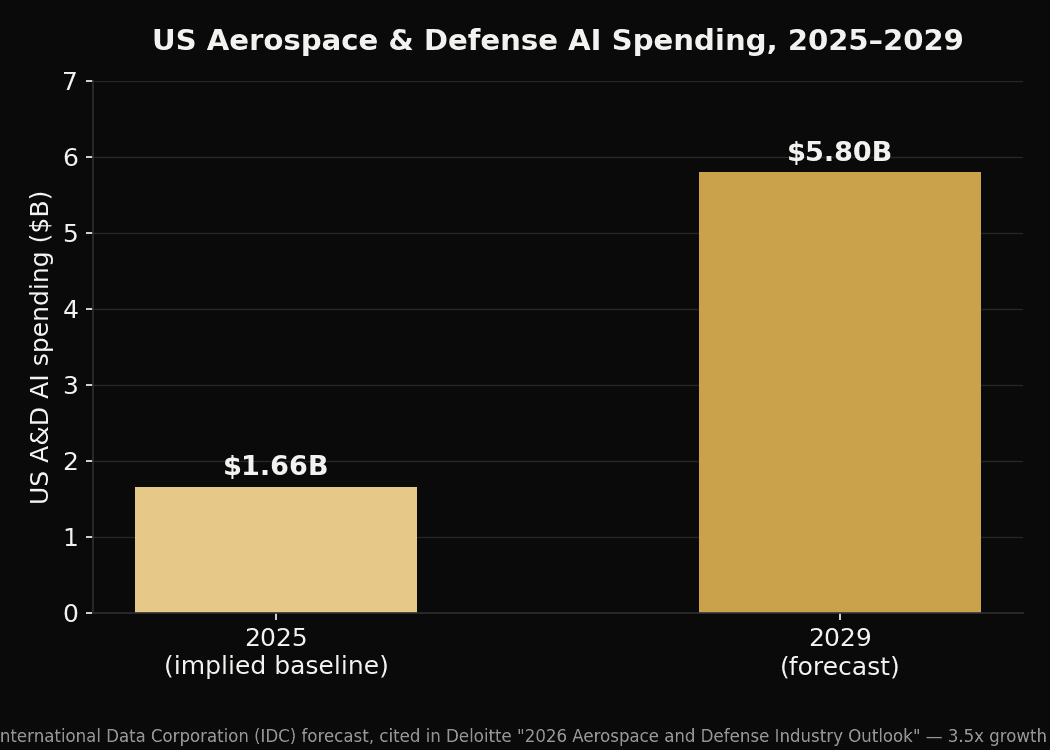
US aerospace and defense AI spending is set to grow 3.5x by 2029 ($5.8B, IDC/Deloitte), while the data-science share of job postings grows only from 3% to 5% over the same period. An economist's read: a race between technology and education (Tinbergen, 1974; Goldin & Katz, 2008), where skill supply is struggling to keep pace with AI capital diffusion.
Deloitte's "2026 Aerospace and Defense Industry Outlook," drawing on International Data Corporation (IDC) forecasts, quantifies the trajectory of AI spending in the US aerospace and defense sector: $5.8 billion by 2029, a 3.5x increase from 2025 (roughly $1.66 billion on that implied baseline). The same report, citing a separate Deloitte study ("From vision to value"), estimates that 36% of tasks in industrial products manufacturing could benefit from agentic AI augmentation — a broad operational transformation potential, not merely a rising technology budget.
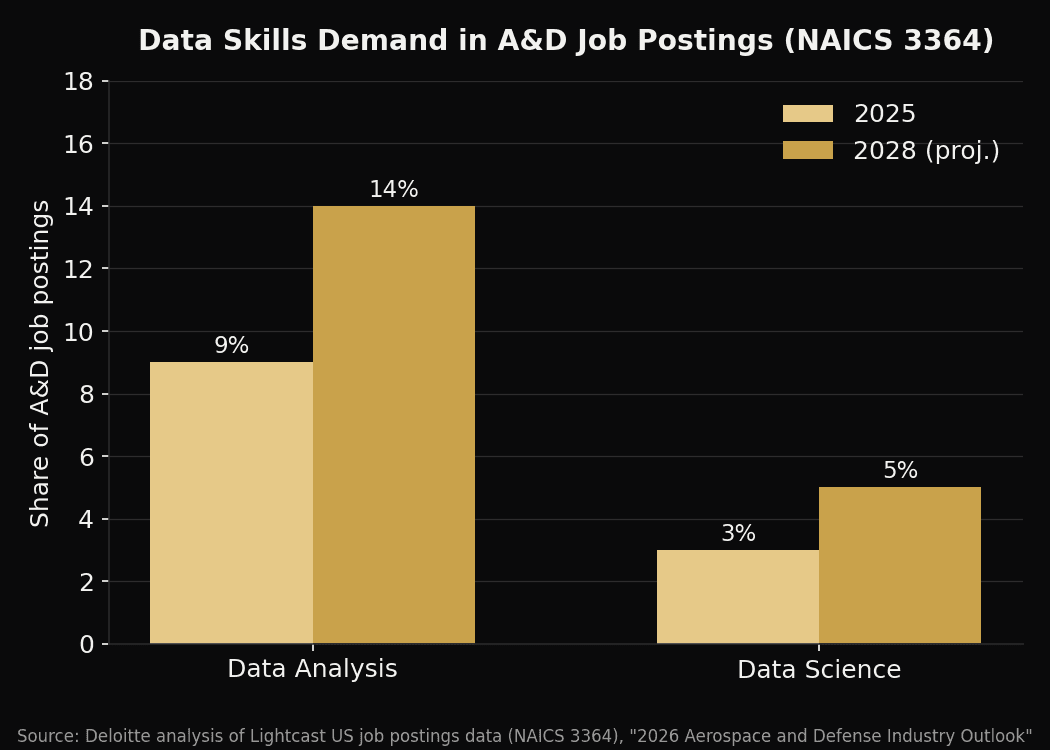
In parallel, Deloitte analyzed Lightcast US job postings for the sector (NAICS code 3364, covering aerospace manufacturing) to measure data-skills demand. The share of postings mentioning data analysis is projected to rise from 9% in 2025 to roughly 14% by 2028 (+56% relative growth), and the share mentioning data science specifically from 3% to 5% (+67% relative growth). These relative growth rates look impressive, but they start from an extremely narrow base: even by 2028, roughly 86% of the sector's job postings still would not mention data analysis at all.
This configuration — technological capital diffusing faster than the skill needed to exploit it — matches what Jan Tinbergen first formalized in 1974 as a "race between technology and education," a concept later developed and empirically substantiated by Claudia Goldin and Lawrence Katz ("The Race between Education and Technology," 2008) across a century of US data. Their central finding: when the pace of technical progress outstrips the pace at which a skilled workforce is formed, it is not the technology itself that stalls, but the availability of complementary skills — with a rising wage premium for skilled workers and effective diffusion running well behind budgetary diffusion.
The difference here lies in the time horizon. The historical episodes studied by Goldin and Katz (electrification, computerization) unfolded over several decades, giving training systems time to adjust. The 2025-2028 window, by contrast, is compressed into four years — not enough time to move a data-skills base from 9% to a level that would match a 3.5x increase in AI budgets. The pacing mismatch is not merely theoretical: it is mechanically built into the calendar of the two curves themselves.
For sector primes, this shifts the nature of the scarce resource. Access to models and compute is now largely commoditized through cloud providers and enterprise AI platforms; what is not commoditized is the organizational capacity to redesign workflows and reskill engineers and technicians to use them. In David Teece's (1986) framework of complementary assets, this capacity is not a substitute for AI capital but its indispensable complement — without which the technology investment stays largely unproductive.
This extends a pattern Cardan-AI has already documented this year: the gap between AI adoption and real absorptive capacity in aerospace and defense (analysis of 08/10), or deployment bottlenecks in upstream oil and gas. The aerospace-defense case adds a directly observable, quantified labor-market measure to what had so far mostly been perception-survey evidence.
The practical implication for decision-makers: treating AI spending and workforce reskilling as a single joint investment, rather than two sequential decisions, is what will let firms capture productivity gains fastest. Organizations that buy tools without investing, at a matching pace, in human capability risk a classic underutilization of production factors — installed AI capital that is insufficiently deployed for lack of a workforce trained to use it.
Analysis by
Cardan-AI Intelligence
Our research and analysis unit, dedicated to applied AI for business, industry and regulatory compliance.
Let's talk about your next competitive edge
A 30-minute conversation to identify your most profitable AI use cases.